
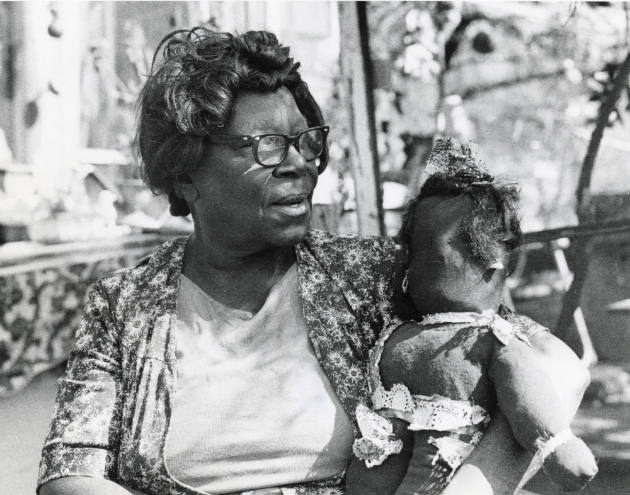

Nellie Mae Rowe
(1900–1982)
BornGeorgia, United States
DiedVinings, Georgia, United States
BiographyNellie Mae Rowe expressed how she saw herself and how she wanted to be seen as a Black woman in the American South who had experienced the oppression of segregation and the dismissal of her artistic ambitions in the service of others. Her practice encompassed brightly colored drawings in crayon and graphite on paper, hand-sewn dolls, painted chewing-gum sculptures, and her own house, which she transformed with art and found objects. She was inventive with the surfaces for her hundreds of mixed-media drawings, using paper as well as pressed paper trays and a wallpaper sample book. She sometimes incorporated photographs of herself into these often-autobiographical works, which feature animals and nature; portraits of herself, friends, and neighbors; and expressions of her faith, such as angels and quotations from gospel music.Born in Fayette County, Georgia, Rowe spent most of her life in the state. She claimed July 4, 1900, as her birthday, aligning herself with the country’s independence and the beginning of a new century. From an early age, she was interested in art. Yet as she recalled, “When I could have been learning how to draw, I had to go to the field. I didn’t have the chance people have now.” Only after two marriages and years of farm work and domestic labor was she able to devote herself to her work. She was then in her sixties and had experienced a transformative period for Black Americans, from being born to a father who had been enslaved to the civil rights era. Her work reflects an exuberance in recovering a childhood passion. She turned her home in Vinings, Georgia, into the “Playhouse,” covering its rooms with drawings and filling its yard with handmade dolls, topiaries, and bottle trees that gleamed in the sunlight.
Her distinctive home attracted local news coverage in the 1970s, and Rowe happily welcomed people into her self-made haven. By the late 1970s, she was exhibiting in galleries, with a key supporter being the gallery owner Judith Alexander. She was included in the exhibition Black Folk Art in America, 1930–1980, which opened in 1982 at the Corcoran Gallery in Washington, D.C. In 1982, shortly before she died that year, she told Alexander in an interview, “When other people have something they don’t know what to do with, they throw it away, but not me. . . . Ever since I was a child, I’ve been that way. I would take nothing and make something.”
Allison C. Meier, 2025
Text written as part of “Rethinking Biography,” an initiative supported by the Institute of Museum and Library Services (IMLS).
Loading ...