

Anna Zemánková
(1908–1986)
BornOlomouc, Czech Republic
ActivePrague, Czech Republic
DiedPrague, Czech Republic
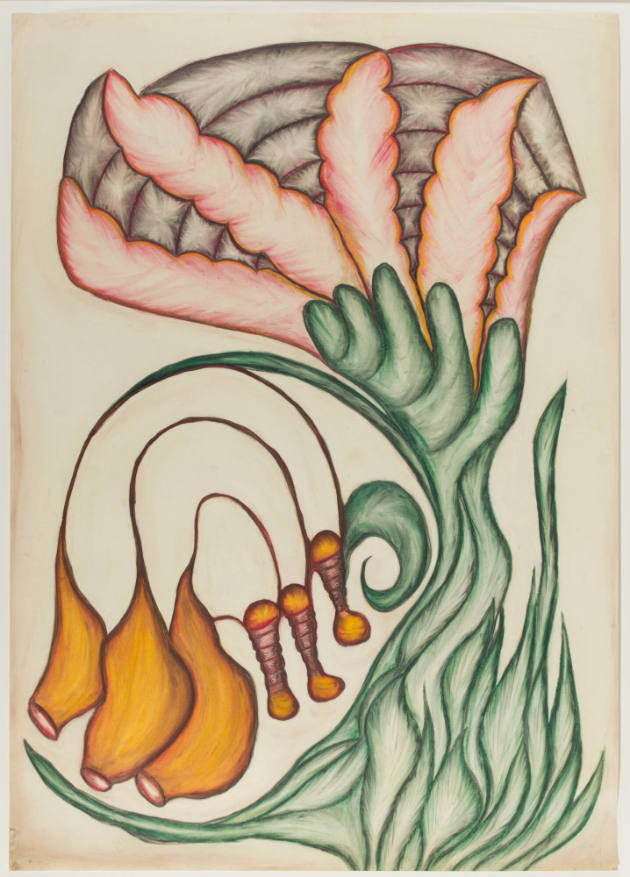
Biography“I am growing flowers that are not grown anywhere else,” Anna Zemánková stated of her otherworldly pastel works on paper. Her intensely colorful drawings and collages depict an imaginary garden in which biomorphic blossoms bloom alongside arabesques of leaves and tendrils unfurling like tentacles. Working in the early morning at a table in her Prague apartment, she listened to jazz and classical music and let the works evolve spontaneously. As she experimented with media over the years, she introduced embellishments such as beads sewn onto the paper, perforated details, embroidered yarn, and satin cutouts. She often drew inspiration from moments in her everyday life: “It is like when a composer hears the first tone, for example a casserole falls on the ground, he hears the sound and catches the tone, which then carries on. It’s like catching a key to something, and that is what I feel when I draw.”Zemánková was born Anna Veselá in 1908 in a village near Olomouc, Moravia (now part of the Czech Republic). She had an early interest in art but instead became a dental technician. She married a military officer in 1933 and had four children, one of whom died young. The Zemánkovás lived in Brno before moving to Prague following World War II. In the late 1950s, her children, including her son, the sculptor Bohumil Zemánek, encouraged her to take up art again as a creative outlet. Although as a teenager she had painted landscapes, she found she enjoyed the fluidity of working with pastels, taking inspiration from the vibrant floral motifs of Moravian folk art traditions.
She started publicly sharing her art in the mid-1960s in “open house” gatherings; these led to formal exhibitions around Prague. In 1979, she was brought to wider attention when she was included in the Outsiders exhibition of self-taught artists at the Hayward Gallery in London. After having both of her legs amputated due to diabetes, she continued to work, but on smaller-scale pieces. She died in 1986. Her work received renewed international acclaim when it was included in the 2013 and 2024 Venice Biennales.
Allison C. Meier, 2025
Text written as part of “Rethinking Biography,” an initiative supported by the Institute of Museum and Library Services (IMLS).
Loading ...