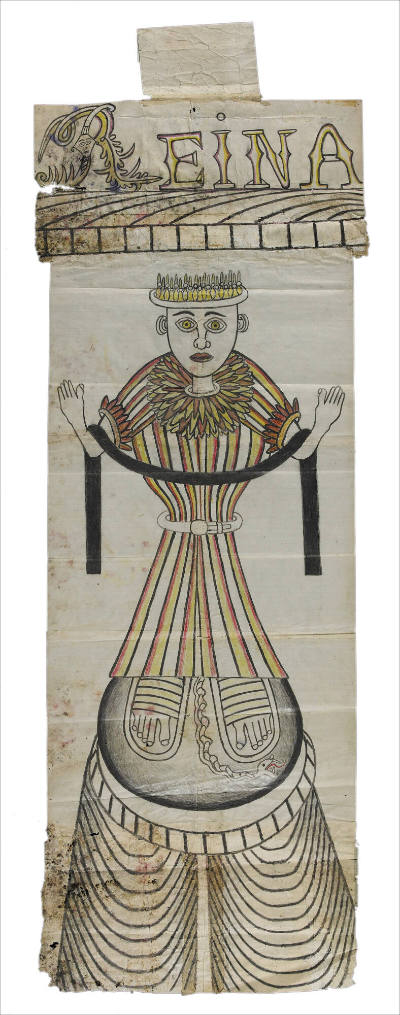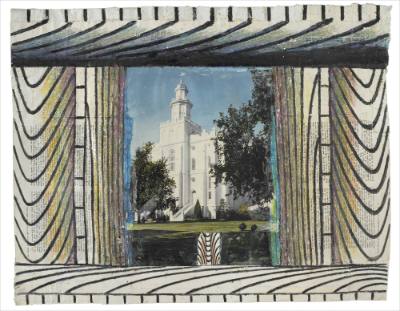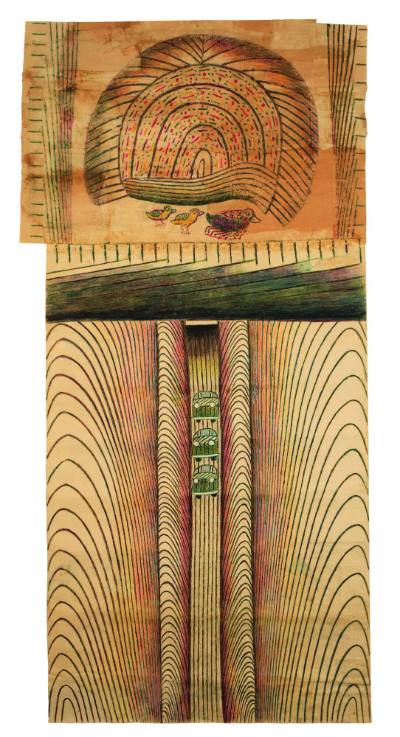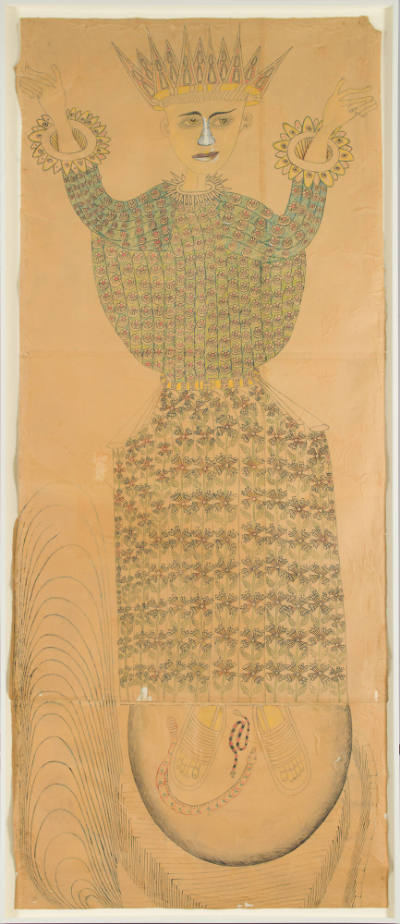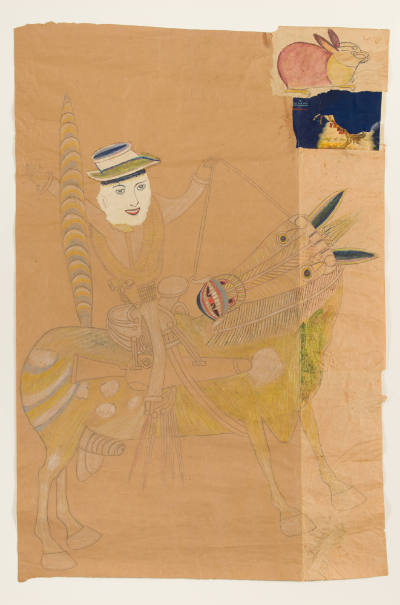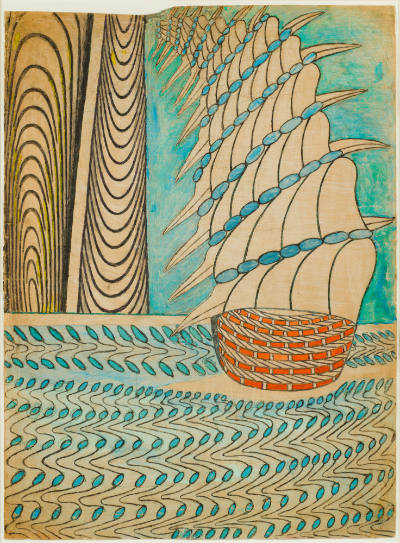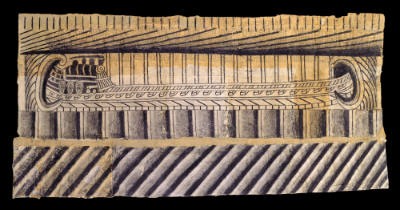
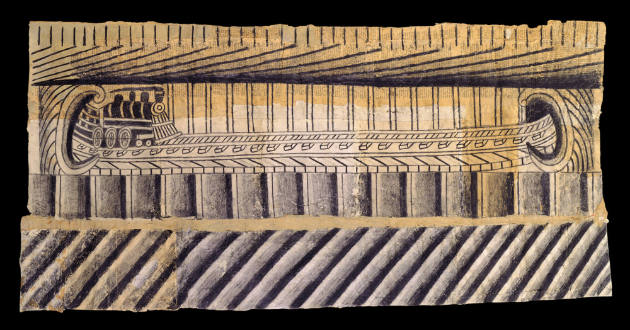
Madonnas, trains, tunnels, churches, animals, and riders on horseback fill the hundreds of drawings created by Martín Ramírez, evoking memories of the people and places he saw in his home country of Mexico and during his life as a migrant in California. The works have an encaustic quality as he used melted crayons to build up scenes collaged from scraps of paper, adding patterns of parallel and undulating lines in paint, crayon, and pencil. Often a boxlike frame, resembling a stage proscenium, surrounds the subject. Some works are monumental, others are small, as he experimented with the materials available, yet always with his precise lines and a distinctive mix of realism and abstraction.
Born in 1895, Ramírez was a ranchero in Tototlán, Jalisco, Mexico, until 1925, when he left, during a time of economic and political turmoil in that country, for the United States to find work on the California railroad and in the mines. The Great Depression put him out of work and onto the street. He was detained by police in 1931, diagnosed without an interpreter (he spoke no English) as schizophrenic, and committed to an institution. The rest of his life would be spent in the California state psychiatric system. His makeshift materials, such as shoe polish, berry juice, charcoal from burned matchsticks, and examination-table paper, reflect how he was able to work with what was on hand alongside more traditional art media. At DeWitt State Hospital in Auburn, California, where he was transferred in 1948 and would stay until his death in 1963, the artist and psychology professor Tarmo Pasto helped bring early recognition to his work, including exhibitions in the 1950s.
Following a 2007 retrospective at the American Folk Art Museum, work from Ramírez’s final years was rediscovered through descendants of Dr. Max Dunievitz, who worked at DeWitt. (Dunievitz organized Ramírez’s first posthumous show in 1963 at the hospital.) These were highlighted in the 2008–09 exhibition Martín Ramírez: The Last Works at the Museum. He is now considered one of the best-known self-taught artists of the twentieth century, and in 2015 the U.S. Postal Service honored him with stamps featuring his art.
Allison C. Meier, 2025
Text written as part of “Rethinking Biography,” an initiative supported by the Institute of Museum and Library Services (IMLS).