
Michael Rothloff
(1855–1930)
BornLeitzburg, Germany
ActiveAthens, Pennsylvania, United States
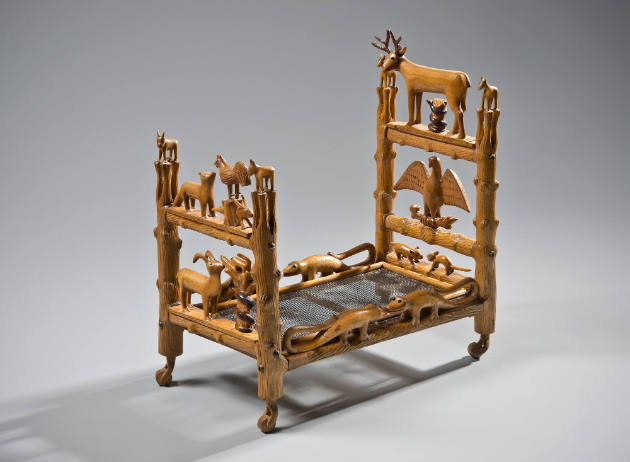
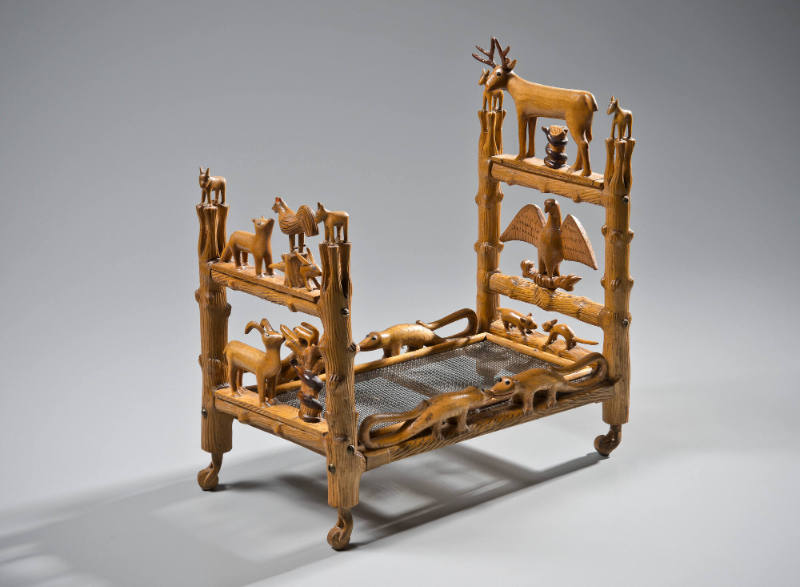
BiographyMichael Rothloff’s imaginative wood sculptures and objects often reflect life in the United States, his adopted country, in the early twentieth century. According to his dated signatures, he carved his incredibly detailed pieces between the early 1900s and the 1920s, painting and creatively accessorizing the blonde-colored fruitwood sculptures. He depicted flappers, women bathers, American military servicemen grasping rifles, and suffragists holding signs and umbrellas. Most of these figures stand just over a foot tall. He also created tributes to American icons, identified on their labeled bases, such as Abraham Lincoln, George Washington, and Uncle Sam, who has an American flag in one hand and an eagle in another. More fantastic, and suggesting a religious or moralistic streak, are the devils with pitchforks and memento mori–style skeletons holding scythes. The most elaborate surviving examples of his work that demonstrate his expert woodworking skill are his furniture pieces that are alive with zoomorphic ornamentation. A pair of lively snakes serves as the back slats for a rocking chair that is crowned with a stag head, and a small bed frame is covered with a whole bestiary, including alligators, dogs, a deer, a fox, a pig, a cat, and more, embedded in its finely made form.Rothloff was born in 1855 in Leitzburg, Germany, and immigrated to the United States in the early 1880s. It is unknown if he was inspired by fanciful European carving traditions such as the Black Forest–style furniture that emerged from Switzerland in the nineteenth century and often incorporated bears, deer, and other alpine animals into its designs. He and his wife, Anna, settled in Athens, Pennsylvania, eventually having eight children. He was known as a talented cabinetmaker. Little is recorded about his life. His 1930 obituary in the Evening Times of Sayre, Pennsylvania, reported that his death at seventy-five followed a long illness and that he worked for many years at the Athens Furniture Company.
A number of his pieces were offered in a 1984 Christie’s sale. Although exhibitions of his art have been infrequent, his works were included in a folk art group show in 2014 at Edward Thorp Gallery in New York and in the exhibition Self-Taught Genius: Treasures from the American Folk Art Museum at the American Folk Art Museum that opened the same year.
Allison C. Meier, 2025
Text written as part of “Rethinking Biography,” an initiative supported by the Institute of Museum and Library Services (IMLS).