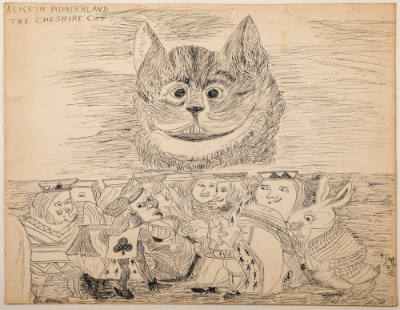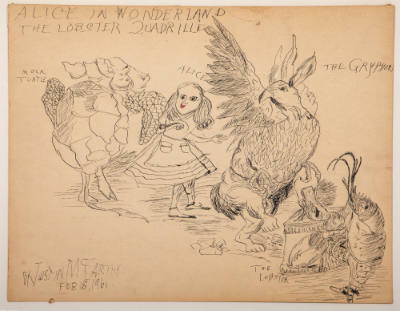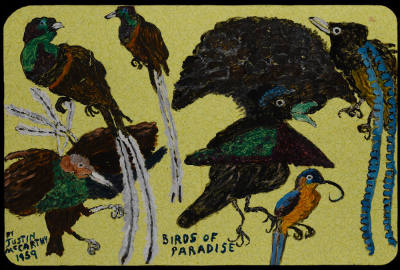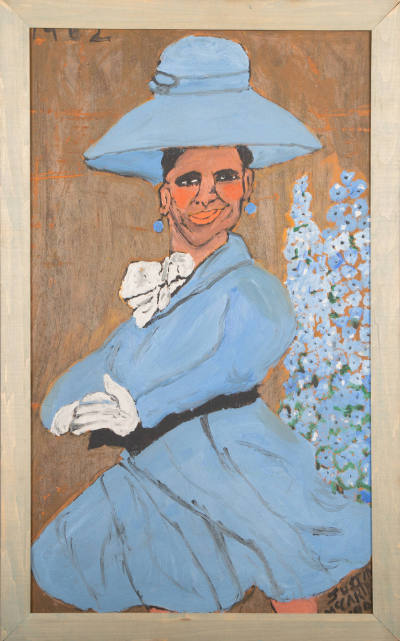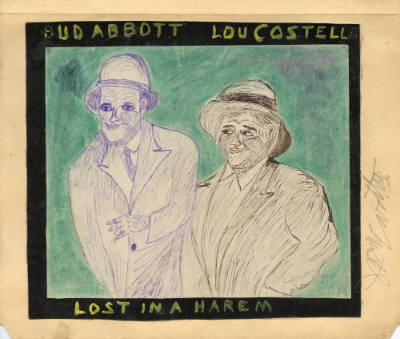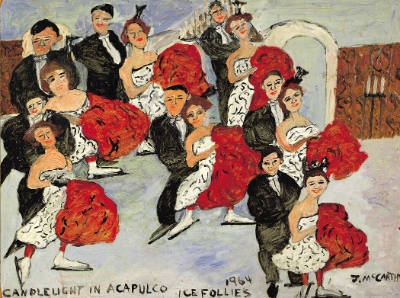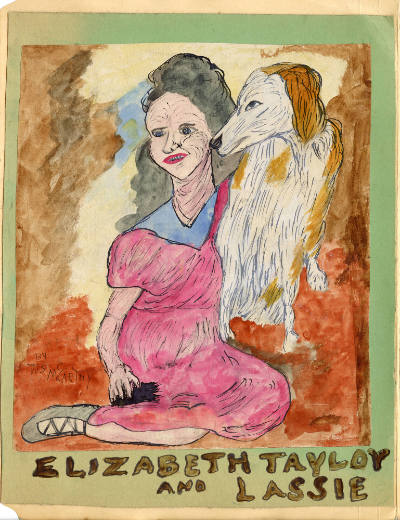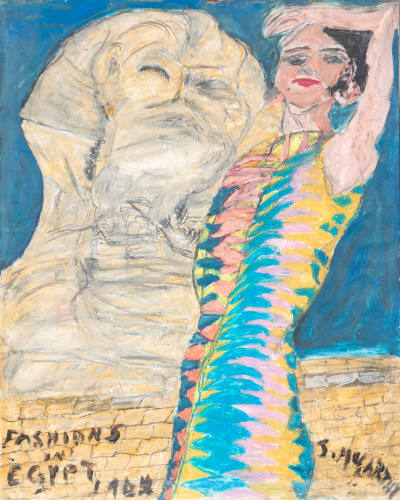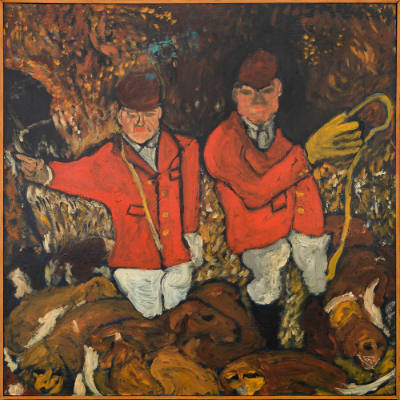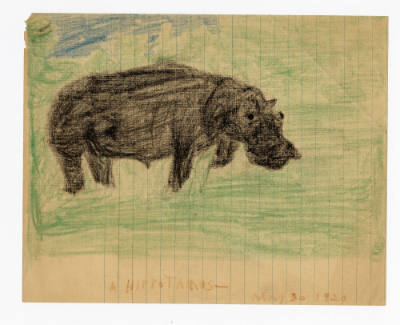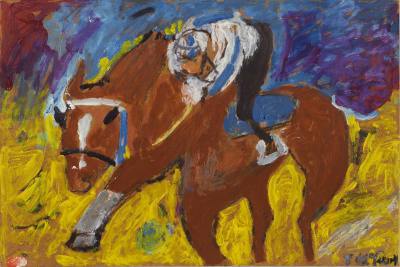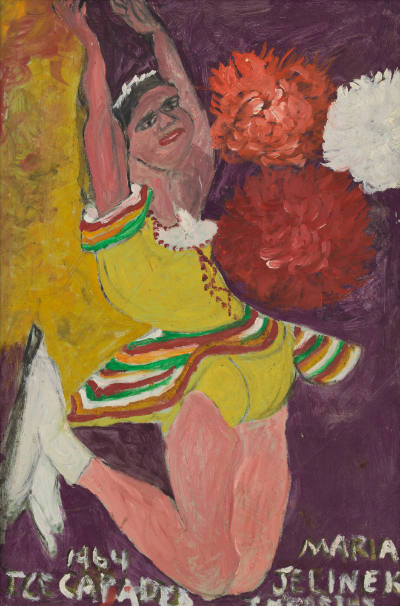
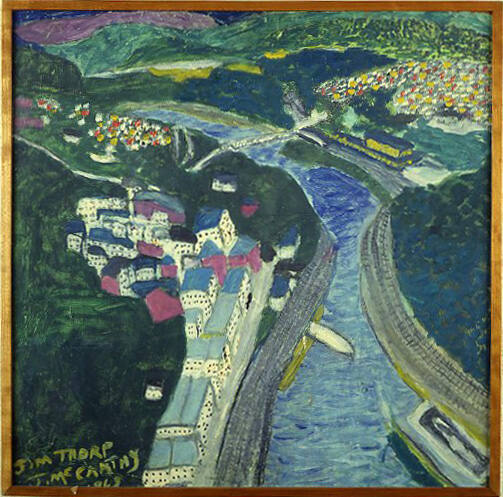
For over fifty years, beginning in the 1920s, Justin McCarthy made paintings and drawings, responding to current events and pop culture, with expressive, saturated color and textural brushstrokes. Although recognition came only in the 1960s, McCarthy persistently created and experimented with materials. Working in oil, acrylic, and watercolor, he frequently used nontraditional surfaces, including Formica tabletops, cardboard, and scraps of wallpaper. Cinema, Hollywood, and popular entertainment were his muses: he depicted movie starlets, fashion models, sports icons, and figures from the Ice Capades, in a style that emphasized an overall impression of a subject rather than its details. Continually finding new sources of inspiration, McCarthy also produced biblical tableaux, landscapes, still lifes, and illustrations, among them ink and pencil scenes from Lewis Carroll’s Alice’s Adventures in Wonderland.
Born in 1891 into an affluent family in Weatherly in eastern Pennsylvania, McCarthy spent most of his life in the small town. His father, John, was an investor and newspaper publisher, and their mansion was designed by the celebrated architect Stanford White. After his younger brother died in 1907, the family went to Europe as a consolation for their grief. While abroad, McCarthy was captivated by the paintings in museums such as the Louvre in Paris. Financial losses in the Panic of 1907, followed by the sudden death of his father in 1908, left McCarthy and his mother, Floretta, in precarious circumstances. Although he was admitted to law school, once enrolled he failed his exams, and in 1915 a nervous breakdown sent him to a psychiatric hospital for several years. It was there that he started to draw and paint.
Returning to Weatherly, McCarthy became best known to his neighbors as a fruit and vegetable peddler, although he was committed to being an artist and attempted to sell his paintings. Alone after his mother died in 1940, he filled the mansion’s disused rooms with his prolific output of paintings and created murals on its walls. A breakthrough came in 1962, when the artists and collectors Sterling and Dorothy Strauser noticed his work at a community art show in Stroudsburg, Pennsylvania. Through their influence, McCarthy was featured in the 1966–67 touring exhibition Seventeen Naive Painters organized by the Museum of Modern Art in New York. In his later years, his worsening eyesight gave his art an abstract quality, with colors colliding in frenetic swirls of paint. As his health worsened, he moved to Tucson, Arizona, where he died in 1977.
Allison C. Meier, 2025
Text written as part of “Rethinking Biography,” an initiative supported by the Institute of Museum and Library Services (IMLS).