
John Podhorsky
(1886–1963)
BornBohemia, Austria-Hungary (now Czech Republic)
ActiveCalifornia, United States
DiedCalifornia, United States
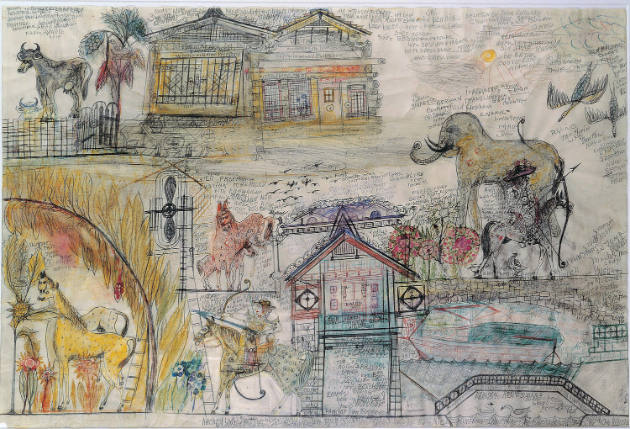
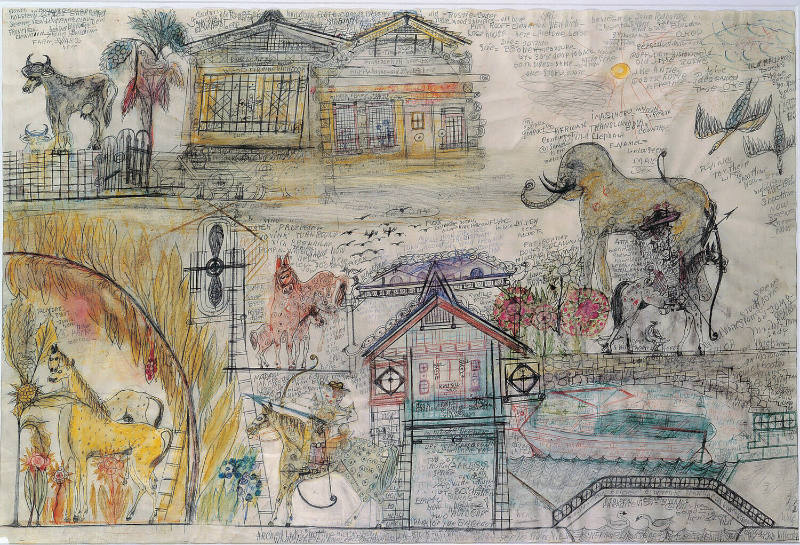
BiographyJohn Podhorsky envisioned fantastic buildings and machines in his meticulously annotated works on paper. Some are sketched in graphite, and others in vivid colored pencil, mixing freehand drawing with precise straight lines. He designed churches with bell towers, grand structures featuring rounded windows and gable roofs topped with weathervanes, and bridges that spanned rivers populated with waterfowl. Figures on horseback hunting with bows and arrows are depicted alongside animals and plants from around the globe, giving these scenes a surreal sense of place. His blueprint-like drawings, which are sometimes double-sided, are labeled with lavish descriptions, both direct, such as “red tiles roof,” and more impressionistic, such as “happy home old style here.” He signed these works “John Podhorsky, Expert Builder.”Like those of many long-term hospital patients, much of Podhorsky’s life remains obscure, though his story has increasingly emerged through research in census and other public records. He was born in 1886 in Bohemia, in the modern-day Czech Republic, and immigrated to the United States as part of a wave that brought hundreds of thousands of Czechs to the United States between 1850 and 1914. His mixing of w’s and v’s in his writing reflects that his first language was Slavic. He married in New York in 1927 and soon moved west to California, where he worked in many industries—as a cabinet maker in Long Beach, later as a contractor at a termite extermination company, and by 1940 at the Alberhill Coal and Clay Company, a sprawling industrial operation in Riverside County. This professional background helps explain his knowledge of and interest in architecture. Though the circumstances leading to his institutionalization around the late 1940s remain unknown, he made all his known works while he was a patient at a California psychiatric hospital in the 1950s and the early 1960s. He died a hospital inmate and was interred in a mass patient grave in 1963.
His artwork gained public recognition through the attention of the psychologist and art professor Dr. Tarmo Pasto. Best known for his involvement with the artist Martín Ramírez, Pasto collected patient-produced art and studied its visual connections to mental illness.
Allison C. Meier and Dylan Blau Edelstein, 2025
Text written as part of “Rethinking Biography,” an initiative supported by the Institute of Museum and Library Services (IMLS).