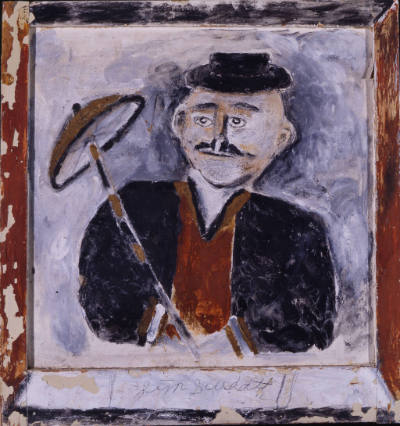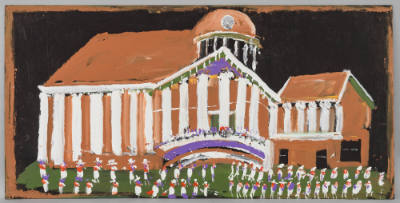
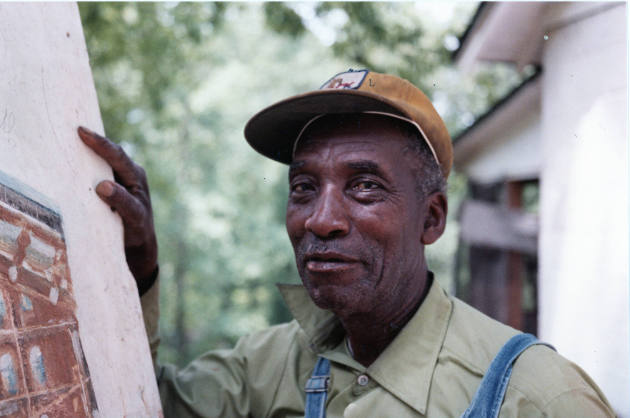
Jimmy Lee Sudduth constantly experimented with color, producing his own pigments for his textural paintings. He derived red from pokeberries, pink from red crepe paper, green from cut grass, black from coal soot, and much more, mixing these materials with mud combined with a sugar or soda binding agent. He said in a 1971 Birmingham News article, “I can scrub leaves on wet paper to get green. Sometimes I hammer green tree buds when they first come out in the spring to get green color, and sometimes I hammer green pine needles on wet paper.” He found that the hard surfaces of wood and metal best supported the heavy strokes of his materials. He tended to work quickly with his fingers, giving his pieces a spontaneous exuberance. He depicted the architecture of rural Alabama, from log cabins to churches, as well as Washington, D.C., monuments and urban skylines. Animals were a favored subject—especially his dog, Toto—as were portraits of people in his community and celebrities. Each reflected his sensitivity to the nuances of color, as he recognized that even the mud around his home offered a variety of earthy hues.
Sudduth (whose first name is sometimes spelled Jimmie) was born in 1910 in Caines Ridge in Fayette County, Alabama, where he spent much of his life. Like many Black children during segregation in the American South, Sudduth received only a limited education. However, he had a strong creative drive, and he would recall being fascinated by painting mud pictures on trees. He later worked in factory and farm jobs, moving to the town of Fayette in the early 1950s. He used his evenings to experiment with art techniques, and in the 1960s, he started painting in earnest with mud and natural pigments.
He began exhibiting his work in the late 1960s and had a 1971 solo show at the Fayette Art Museum—its director, Jack Black, was an early promoter. The exhibition contributed to his local and national acclaim, as did his spirited appearances at area arts festivals playing his blues harmonica. In the early 1990s, when making his own materials became difficult for the aging artist, he used acrylic paints applied with a sponge brush. He died in 2007. As he stated in a 1992 interview, “I paint with my finger ’cause that’s why I got it, and that brush don’t wear out. When I die, the brush dies.”
Allison C. Meier, 2025
Text written as part of “Rethinking Biography,” an initiative supported by the Institute of Museum and Library Services (IMLS).