

Jesse Howard
(1885–1983)
BornShamrock, Missouri, United States
ActiveFulton, Missouri, United States
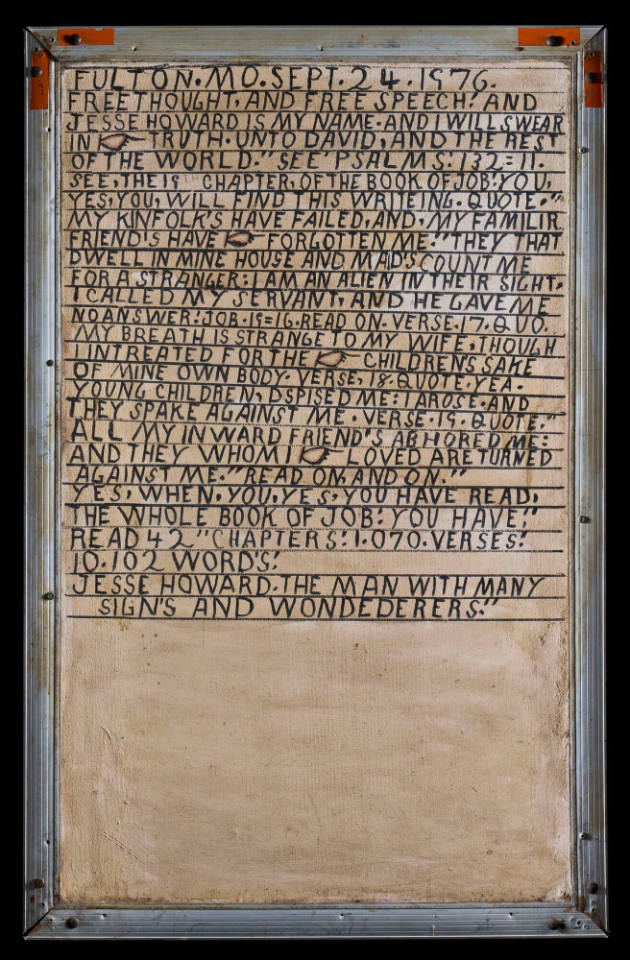
BiographyJesse Howard nicknamed his home in rural Missouri “Sorehead Hill” and “Hell’s 20 Acres.” No one passing by the site could avoid being assailed by the many handmade signs expressing his thoughts about the state of the world, the country, and his own life. “FREE THOUGHT AND FREE SPEECH! AND JESSE HOWARD IS MY NAME,” declared one hand-lettered sign from 1976 made by the opinionated artist also known as Jesse “Outlaw” Howard. In black all-caps letters, he painted whitewashed wood and metal panels with neat but dense lines of text. He sometimes punctuated his quotations from Bible verses, proverbs, country remedies, cantankerous diatribes on local politics, and thoughts on morality with red highlights and pointing hands like a medieval scribe.Howard was born in Shamrock, Missouri, the youngest of ten children with his twin sister, Myrtle. After receiving a sixth-grade education, he led an itinerant life as a migrant laborer before returning home in 1905. He eventually bought a house and twenty acres of farmland outside Fulton, Missouri. He made his first sign in the 1940s after a wooden airplane he had whittled was vandalized.
Vandalism and theft would continue to plague Howard’s evolving art environment over the years. Some signs were made in direct response to previous infractions, such as one from 1960 that begins, “SOME THIEF, OR THIEVES, STOLE THE TEN COMMANDMENTS RIGHT OFF THIS FENCE. I JUST WONDER WHO WOULD STOOP SO LOW AS TO PULL A STUNT LIKE THAT.” In the early 1950s, the local community made an unsuccessful attempt to have him institutionalized. Alongside the proliferation of signs channeling his fervent religious and political beliefs, he also made wooden tombstones to represent biblical burial sites and adorned his home with assemblages created from old farm equipment and salvaged objects.
Artist and curator Gregg Blasdel highlighted Howard in his seminal 1968 Art in America essay “The Grass-Roots Artist,” leading to his work being featured in the 1974 exhibition Naives and Visionaries organized by Blasdel and Martin Friedman at the Walker Art Center in Minneapolis. In 1977, the Kansas City Art Institute invited Howard to speak and present his work in a celebration of free speech called “Jesse Howard Day.” In the years following his death in 1983, all that was left from his once unruly yard was a discarded saw hammered to a tree.
Allison C. Meier, 2025
Text written as part of “Rethinking Biography,” an initiative supported by the Institute of Museum and Library Services (IMLS).