
Friedrich Schröder-Sonnenstern
(1892–1982)
BornTilsit (now Sovetsk), East Prussia (now Russia)
DiedBerlin, Germany
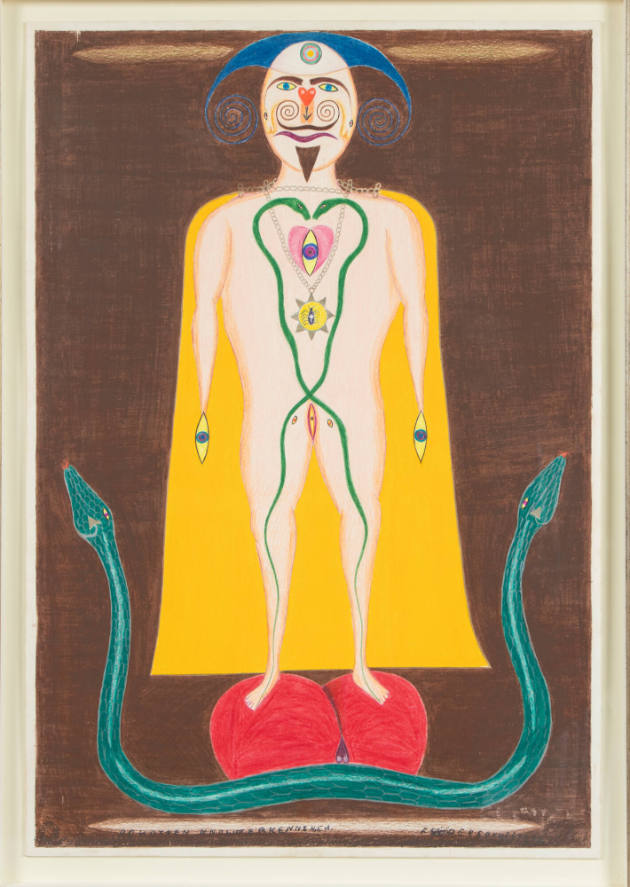
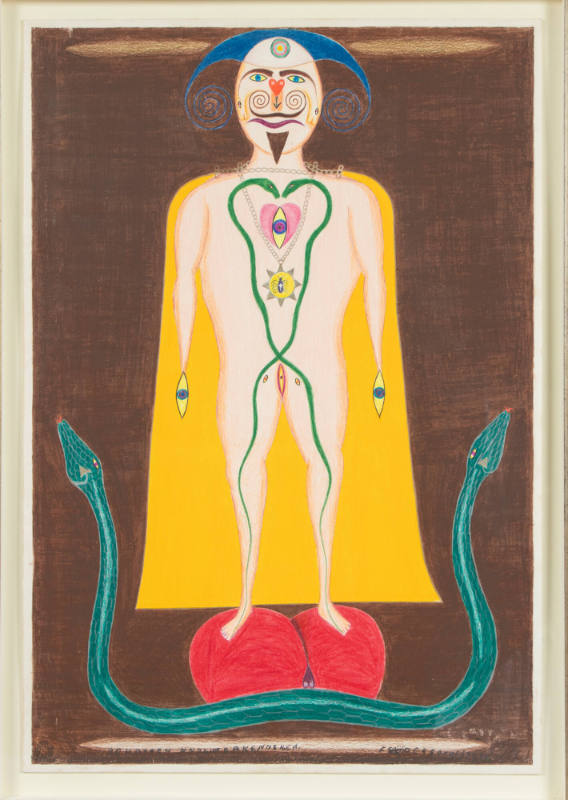
BiographyNightmarish and erotically charged, Friedrich Schröder-Sonnenstern’s colored-pencil drawings channel, in a series of bestial creatures, the hellish fallout of postwar Germany. Frequently, there is a tension between those with power and those without, whether manifested in violence or in scatological imagery, that seems to satirize society’s attempts at masking its depravity. Angels, devils, magicians, jesters, and buxom human-animal hybrids are rendered in extraordinary color; motifs of recurring symbols, such as smiling suns, skulls, rainbows, snakes, gazing eyes, and hearts—perhaps reflecting Schröder-Sonnenstern’s esoteric interests—recur in the vivid lines of the compositions.The details of Schröder-Sonnenstern’s itinerant life are as fantastic and fluid as are his strange subjects who always seem to be in a state of transformation. He often did his own mythologizing, from promoting himself as a quack doctor to proselytizing as a street prophet. He was born Emil Friedrich Schröder in 1892 in Kaukehmen near Tilsit, East Prussia. A pattern of disruptive behavior led to much of his youth being spent in reform schools and psychiatric hospitals. His series of self-made identities as a young man included being a leader of his own religious sect and Professor Dr. Eliot Gnass von Sonnenstern (Sonnenstern meaning “sun star”) as he peddled palmistry and natural cures. He managed to survive a World War II labor camp, emerging in a devastated Berlin scavenging firewood to sell from the wreckage. In 1949, he started creating his drawings, first in graphite and then exclusively working in colored pencil on board.
By the 1950s, he had attracted the interest of the Berlin dealer Rudolf Springer; artists such as Hans Bellmer and Friedensreich Hundertwasser were also enthralled by his uncanny imagery. He was included in exhibitions around Europe, particularly on surrealism, such as Exposition inteRnatiOnale du Surrealism (E.R.O.S.) organized by Marcel Duchamp and André Breton in Paris in 1959. After the death of his longtime partner, Martha Möller, in 1964, his work became more sporadic as he struggled with alcoholism, and his reputation was tarnished by his signing works produced by assistants. He died in 1982 in Berlin.
Allison C. Meier, 2025
Text written as part of “Rethinking Biography,” an initiative supported by the Institute of Museum and Library Services (IMLS).
Loading ...