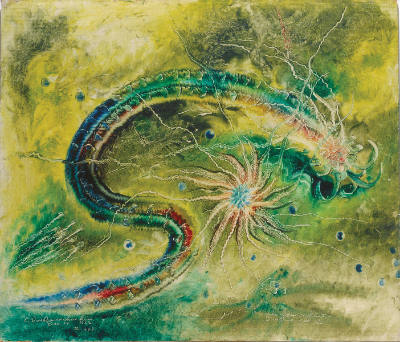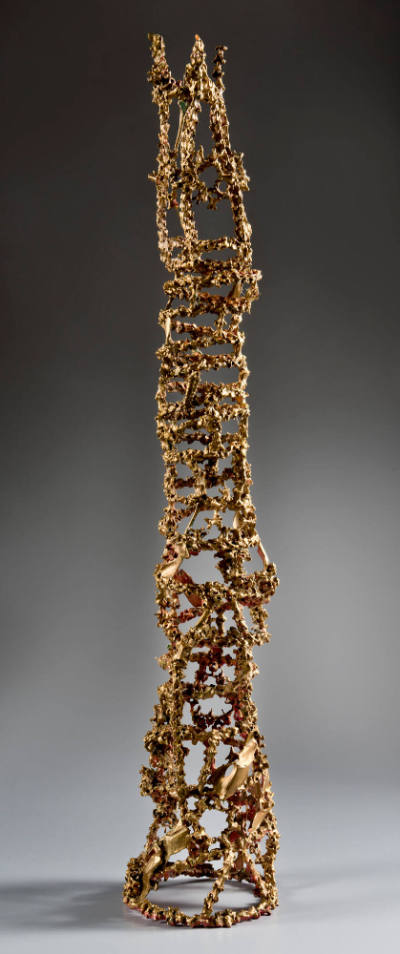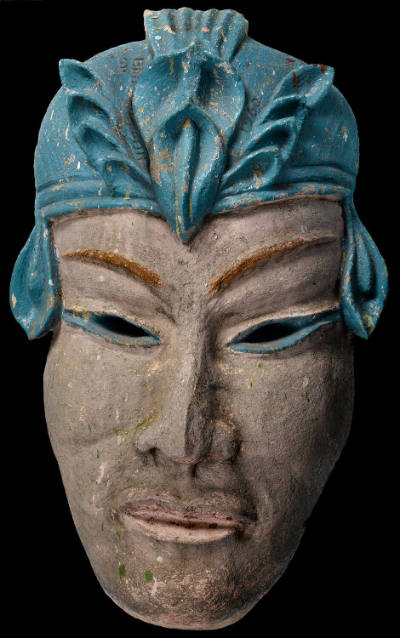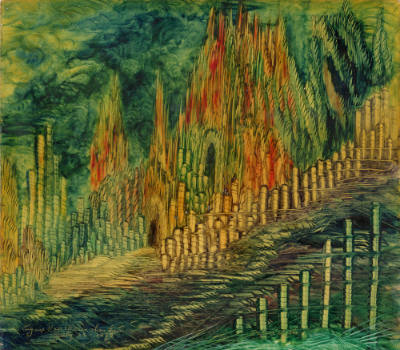
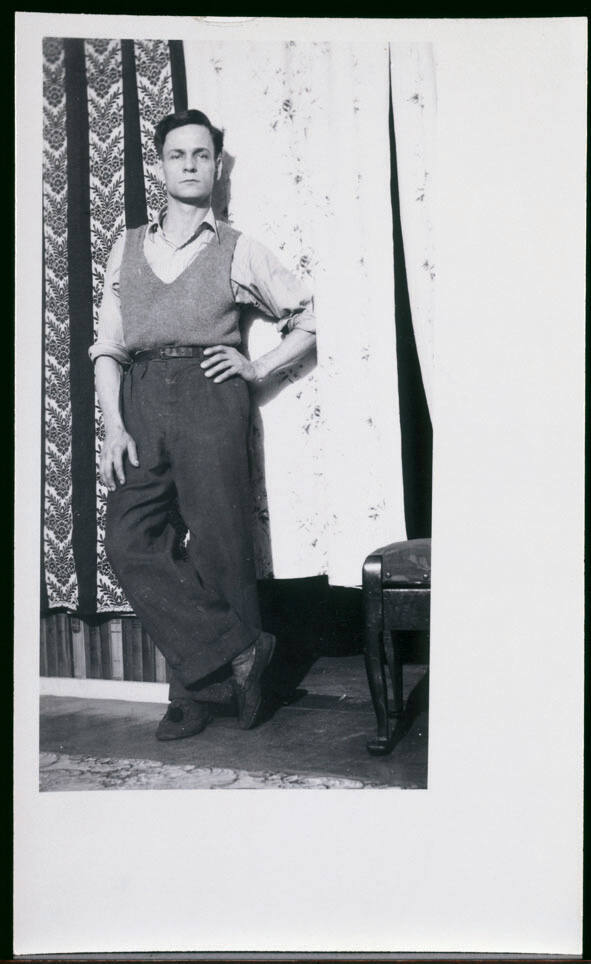
In words that he inscribed on a tile in his kitchen, Eugene Von Bruenchenhein made clear the breadth of his artistic ambition: “Freelance Artist—Poet and Sculptor—Inovator—Arrow maker and Plant man—Bone artifacts constructor—Photographer and Architect—Philosopher.” Tirelessly inventive, he sculpted foliate vessels and crowns out of clay excavated from construction sites and built miniaturized towers and thrones from chicken and turkey bones painted metallic colors. The artistic kingdom created within his home in a Milwaukee suburb was shared with his muse and collaborator, Marie—who posed in a range of personas as a pinup, a goddess, and a starlet in thousands of photographs. He sometimes used brushes made from her hair for his paintings, in which he grappled with cosmic and planetary forces in psychedelic abstract patterns that engulfed mushroom clouds, fantastic creatures, botanical forms, and sci-fi cities. These concerns about nature, love, and war were also expressed in his poetry, which he taped on a reel-to-reel recorder; in one spoken-word piece, he stated, “Look to the present youth who seek their own little world today.”
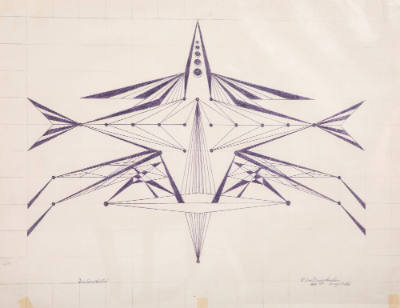
Edward Eugene Von Bruenchenhein was born in Marinette, Wisconsin, in 1910. His family later moved to Milwaukee, where he spent most of his life. His passion for art and nature was nurtured by his stepmother, Elizabeth Mosely, who painted still lifes and had an interest in metaphysics. Into the late 1950s, he held various jobs, including as a florist and baker. In 1943, he married Eveline Kalke, whom he nicknamed Marie. At their West Allis, Wisconsin, home, there were no lines between life and art, from the bathroom that served as a darkroom, to the stove in the living room where ceramics were fired, to the exterior of the house, painted blue, pink, and yellow. They lived meagerly, scraping by on Von Bruenchenhein’s social security checks, yet he had a boundless capacity to innovate with materials. A wallpaper sample book became a surface for his intricate drawings, and he employed sticks and combs to manipulate the intense colors in his apocalyptic paintings, influenced by the 1950s hydrogen bomb tests.
Von Bruenchenhein tried unsuccessfully to exhibit his art in Milwaukee galleries, and his work remained known only to family and a handful of friends. After he died, in 1983, his friend Daniel Nycz contacted Russell Bowman, the director of the Milwaukee Art Museum, who connected with Ruth Kohler of the John Michael Kohler Arts Center. The Kohler Arts Center subsequently catalogued, conserved, and acquired much of Von Bruenchenhein’s work.
Allison C. Meier, 2025
Text written as part of “Rethinking Biography,” an initiative supported by the Institute of Museum and Library Services (IMLS).