
Ellis W. Ruley
(1882–1959)
BornNorwich, Connecticut, United States
DiedNorwich, Connecticut, United States
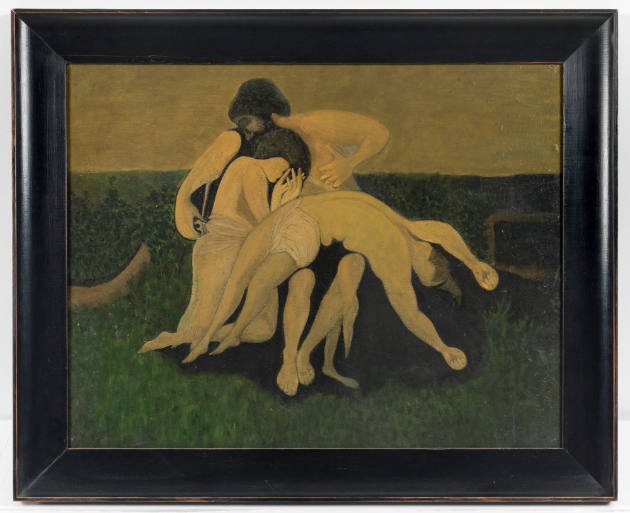
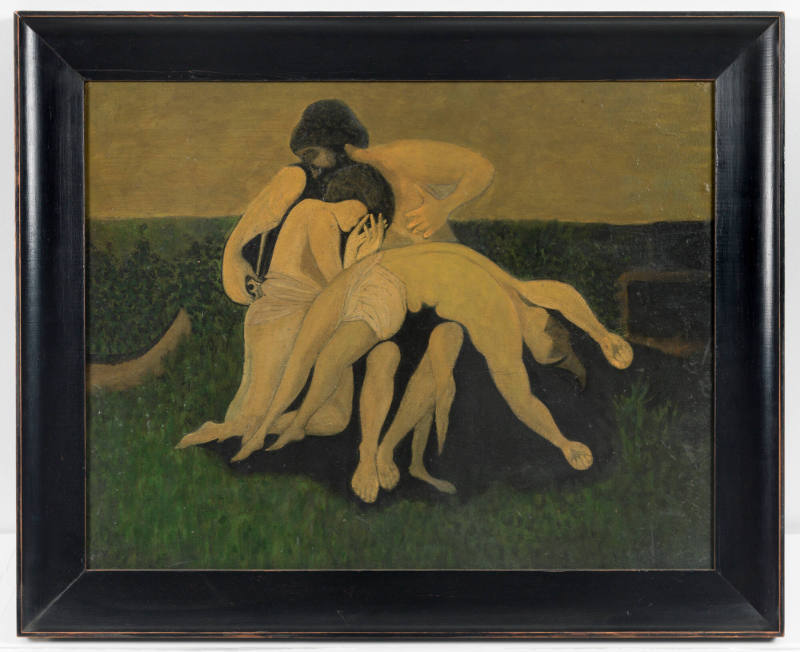
BiographyWith a flattened perspective and oil-based house paint, Ellis Ruley depicted idyllic scenes of rural Connecticut and exotic wild animals living in harmony. He referenced images from magazines, advertisements, and other sources, including for biblical subjects, such as Pieta, inspired by a calendar print of a William-Adolphe Bouguereau painting. Landscapes and gardens frame these compositions, in which lions rest peacefully alongside antelopes and figures ride horses in the countryside. Yet there is a shadow of vulnerability to these moments—the knowledge that the peace and pastoral beauty they capture could be easily disrupted. Ruley was familiar with this tension as he made a rustic haven for his family while experiencing hostility as a well-off Black man married to a white woman in the pre-civil rights era. Born in 1882, he grew up in Norwich in northeastern Connecticut. His father had fled slavery in the South. Ruley began working at an early age, spending years as a mason in construction. A work-related accident in 1929 led to a large compensation, allowing him to buy an eighteenth-century farmhouse on several wooded acres on Norwich’s outskirts. With his wife, a German woman named Wilhelmina Fox, he renovated the property into a self-sufficient home, despite tensions with his white neighbors. Some of his earliest artwork was decorating their window screens. He started painting seriously around the late 1940s, using surfaces such as posterboard, Masonite, and cardboard, and stamped his signature as Ellis W. Ruley. He became involved in the Norwich Art Association and was active in selling his work. The interest of Joseph Gualtieri, the director of the Slater Memorial Museum in Norwich, led to a 1952 display of his art.
His life ended under still-mysterious circumstances on a frigid night in January 1959, when he was found dead with a head injury in his driveway. Although it was deemed accidental at the time, a later autopsy in 2014 declared his cause of death undetermined. Over sixty of his works have been identified out of hundreds that he likely completed, as some are believed to have been lost when his home burned down after his death. The publication of Discovering Ellis Ruley: The Story of an American Outsider Artist by Glenn Robert Smith in 1993 and a 1995–97 traveling retrospective organized by the San Diego Museum of Art brought national recognition to his art. In 2018, his former home was dedicated as the Ellis Walter Ruley Memorial Park.
Allison C. Meier, 2025
Text written as part of “Rethinking Biography,” an initiative supported by the Institute of Museum and Library Services (IMLS).
Loading ...