
Nathan Hilu
(1926–2019)
BornNew York, New York, United States
ActiveJapan
DiedNew York, New York, United States
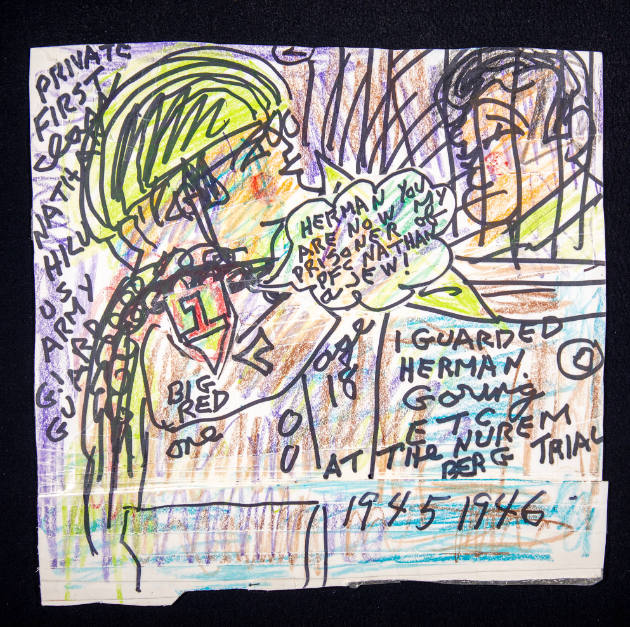
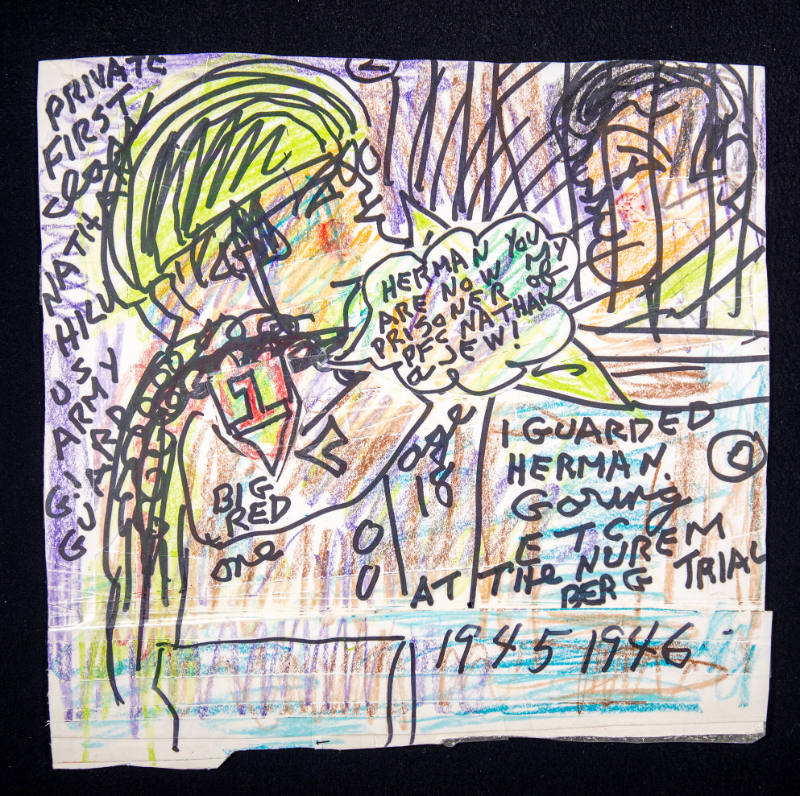
BiographyNathan Hilu drew with a fervent urgency to ensure that the past was not forgotten. He worked quickly with marker, pen, pastel, and crayon, the bright colors spilling over frenetic black lines on drawing paper or discarded envelopes, folders, and pieces of cardboard. The drawings were annotated with dense text and collaged with cutouts—from books, newspapers, printouts, and other sources—sometimes attached with packing tape. Some are standalone pieces; others are bound together as books. The themes of his prolific works varied widely, from biblical stories to depictions of historical events, but they were always highly personal and conveyed from his perspective as a Jewish veteran who had experienced the once-vibrant cultural life of New York’s Lower East Side and served as a soldier during World War II, witnessing the Nuremberg trials. As he once told The Jewish Week, “I’m a rememberer.”Hilu was born in 1926 to Syrian Jewish immigrants on New York City’s Lower East Side. His family later moved to Pittsburgh, and he grew up attending the Irene Kaufmann Settlement and the Hebrew Institute. In 1943, at age eighteen, he enlisted in the U.S. Army and was stationed in France and Austria. By 1945, he was transferred to Germany, where he was part of the security detachment for the Nuremberg Prison and trials. High-ranking Nazi war criminals such as Hermann Göring, Ernst Kaltenbrunner, Albert Speer, and Julius Streicher appear over and over in his drawings, usually with Hilu himself speaking to them through the bars. Following the trials, he remained in the Army and was later stationed in Japan during the Korean War. In the early 1990s, after returning to New York, he became a longtime employee of a book and magazine distributor.
He began exhibiting his drawings in the late 1970s in New York galleries, particularly his drawings of Jewish life on the Lower East Side, including its kosher lunch counters, synagogues, and celebrations. In 2011, a solo exhibition of his art opened at the Dr. Bernard Heller Museum at Hebrew Union College in Greenwich Village. Before his death in 2019, he was interviewed for the documentary film about his life and work, Nathan-ism, directed by Elan Golod. The film was released in 2023.
Allison C. Meier and Caroline Culp, 2025
Text written as part of “Rethinking Biography,” an initiative supported by the Institute of Museum and Library Services (IMLS).