

Shirley Cohen
(1922–2019)
BornNew York, New York, United States
ActiveForest Hills, New York, United States
DiedForest Hills, New York, United States
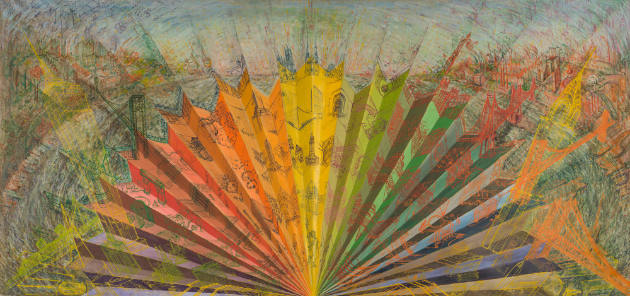
BiographyThrough her art, Shirley Cohen examined where humanity comes from and where it could be going. In swirls of color, she touched on subjects ranging from space travel to spirituality, conveying perspectives of wonder regarding humanity’s accomplishments and concern about its tendency to destruction. Exploring themes such as the achievements of technology and the importance of family, Cohen’s paintings took a variety of forms, including landscapes of imagined and witnessed places, architectural views as seen from the skies, and murals that filled whole rooms of her home. She worked mostly in oils but occasionally added textural elements such as coffee grounds to her paints or used glass as a surface, and she experimented with giving her canvases dimension by folding or ruching the material. Many of her compositions mix abstraction and realism, such as Color Span of Manhattan According to the Architectural Development of the 1960s (c. 1960–65), in which a rainbow fan opens to reveal city structures within its folds. In one of her most striking paintings, Facing the Future (1995), her two grandsons are depicted on either side of their adult selves, envisioned as radiant astronauts striding forward from a prismatic shape evoking a spacecraft. Divided across four canvas panels, the work shows the subjects’ pasts angling away from them into a bucolic landscape where the sun appears to be setting, with their parents observing their destinies on either side.Cohen was born in 1922 in New York. At the age of two, she was separated from her three siblings and put in foster care when their mother was institutionalized in a psychiatric hospital. After high school, she took night classes at the Fashion Institute of Technology in New York while holding a day job at Simplicity Patterns. Following her marriage in 1942, she worked as a partner with her husband in a women’s sportswear company in Manhattan’s Garment District. During World War II, she served in the U.S. Army Signal Corps as an airbrush artist in the filmmaking division. This experience and the optimism and anxiety of the postwar era shaped the art practice that she nurtured in private. Over six decades, she made both small works and large-scale murals that covered the walls and ceilings of her home in Forest Hills, Queens.
Cohen never promoted or shared her art outside of her family. Only after she died in 2019 was it brought to public attention by her family.
Allison C. Meier, 2025
Text written as part of “Rethinking Biography,” an initiative supported by the Institute of Museum and Library Services (IMLS).