

Pietro Ghizzardi
(1906–1986)
BornSan Pieto di Viadana, Italy
ActiveBoretto, Italy
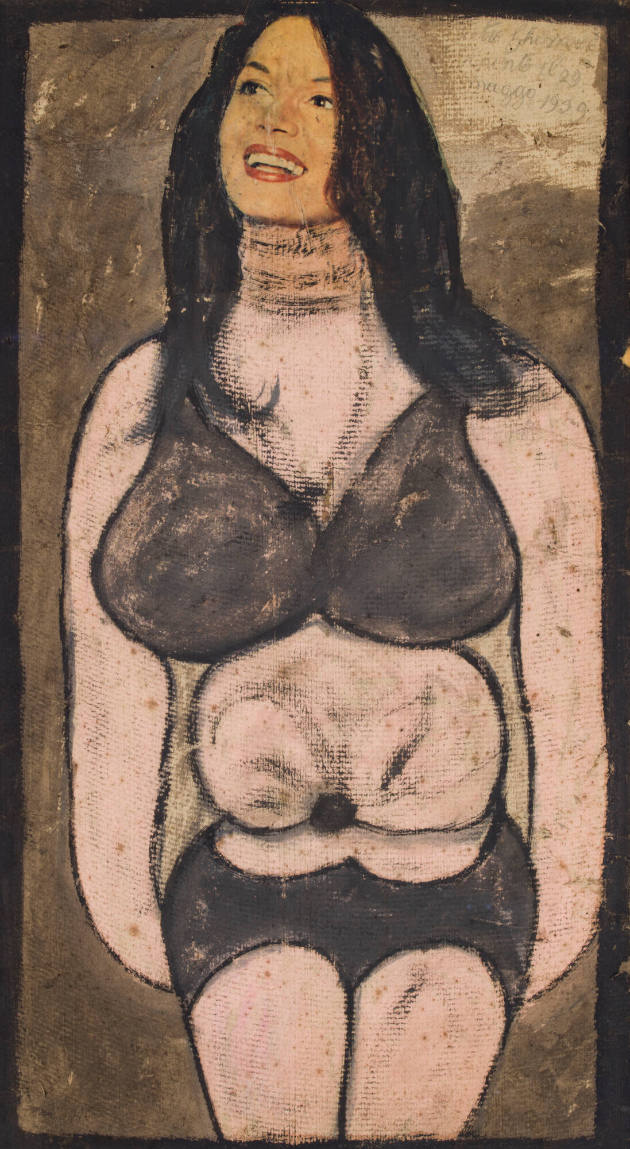
BiographyPietro Ghizzardi resourcefully used the materials around his home in rural Italy to make an impressive range of creative works, including large-scale murals, sculptures, and writing. He created his own pigments for his paintings with materials such as coal, grass, wine, brick dust, berry juice, and even blood, and salvaged scraps of cardboard and paper for his canvases. Although some of his subjects were based on everyday life in his agrarian community, including portraits of his neighbors and animals such as dogs, cows, and birds, others reflect his engagement with popular mass media. Frequently he cut heads of women, particularly film stars, from magazines and then illustrated their bodies provocatively exposed. The crispness of the collaged photographs contrasts with the dark, furrowed contours of the voluptuous painted bodies. He also depicted exotic animals, religious scenes, and historical figures with the same heavy, curved lines.Ghizzardi was born in 1906 in the Mantua region of northern Italy to parents who were agricultural day laborers. His family was often on the move. They settled in Boretto, Italy, in the early 1930s. He later worked in manual jobs as well as farm labor. In his autobiography, Ghissardi, he wrote that he started painting in 1929. His art became a daily practice; he used his farmhouse as a studio and claimed as inspiration the work of Italian Renaissance masters.
By the late 1960s, his paintings were being included in exhibitions of then called “naïve” art in Italy. His autobiographical Mi richordo anchora [I Still Remember] (1976) was honored with the prestigious Viareggio literary prize in 1977. Ghizzardi died in 1986. In 1992, his former home in Boretto was established as a museum, and it now holds the largest collection of his work.
Allison C. Meier, 2025
Text written as part of “Rethinking Biography,” an initiative supported by the Institute of Museum and Library Services (IMLS).
Loading ...