
Charlie Willeto
(1897 or 1906–1964)
BornNageezi, New Mexico, United States
ActiveBlanco Canyon, New Mexico, United States
DiedNageezi, New Mexico, United States
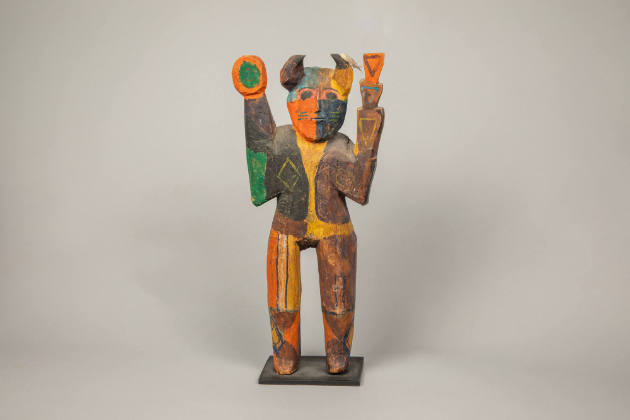
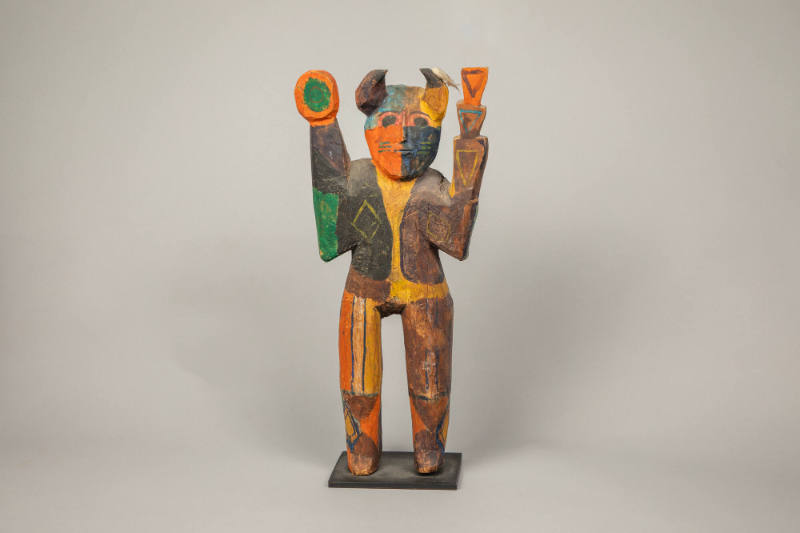
BiographyNavajo, or Diné, artist Charlie Willeto carved wooden sculptures reminiscent of the figurines that he used in a ceremonial context as a medicine man. Yet this work was a break from Navajo tradition, as he created these figurative representations of people and animals as artistic objects intended for public consumption. In a prolific period between about 1961 and his death in 1964, he made around four hundred of these pieces, each standing only a few inches tall; other, more ambitious, works are over five feet in height. They depict Navajo people wearing jewelry, concho belts, and blankets, as well as animals of the American Southwest, including lizards and anthropomorphic wide-eyed owls. Some are more fantastic, such as human figures with horns and a tiger jumping through a flaming hoop. After he roughly hewed them with a hatchet, saw, ax, and knife from cottonwood and discarded pine boards, he painted the figures with geometric patterns that evoke the designs of Navajo rugs, sand painting, and rock art.Willeto was born near Nageezi, New Mexico, in the Navajo Nation, in 1897 or 1906, according to conflicting dates recorded in different sources. He followed in his father’s footsteps to become a tribal healer and spent much of his life in the remote landscapes northeast of Chaco Canyon. He started making his work in part to help support his family of six children. His wife, Elizabeth, painted some of his figures, and some of his earliest pieces were colored with her rug dye, causing them to fade over time. Although his sculptures are sometimes called “spirit figures,” this is a term seemingly applied by collectors rather than Willeto himself. Yet the repeated poses with arms raised suggest people praying or in an act of supplication.
His work became more vibrant as he used increasingly expressive colors over time, from earthy tones to bright blues, greens, and yellows. He sold and traded his work at local trading posts, leading to attention from collectors. His art is now held by numerous major museums. Willeto’s family has carried on his legacy in their own carving work.
Allison C. Meier, 2025
Text written as part of “Rethinking Biography,” an initiative supported by the Institute of Museum and Library Services (IMLS).
Loading ...