
Fleury-Joseph Crépin
(1875–1948)
BornHénin-Liétard, France
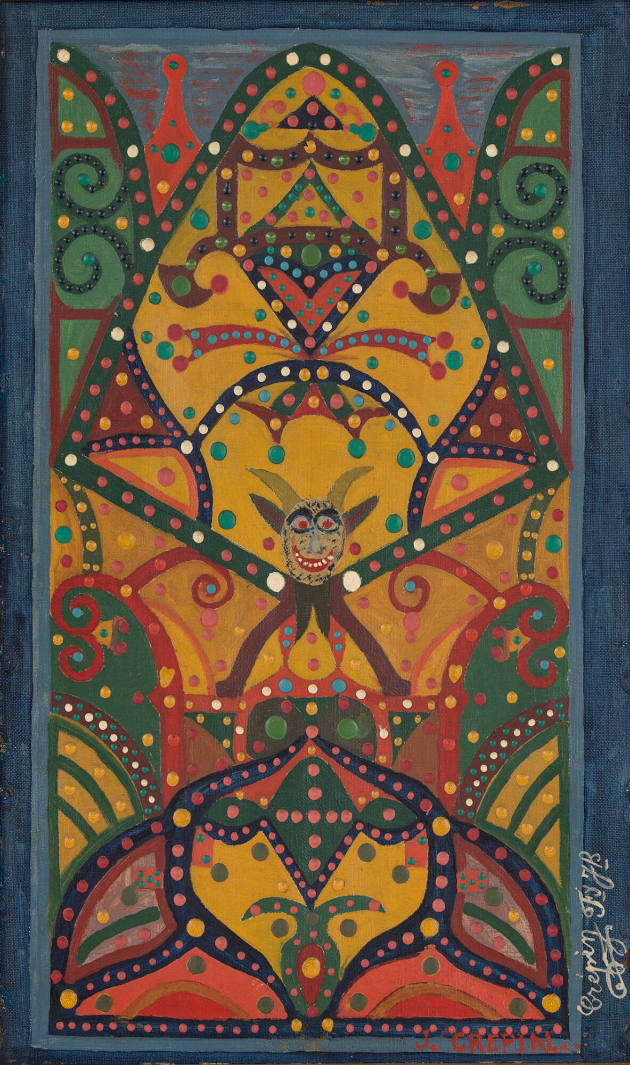
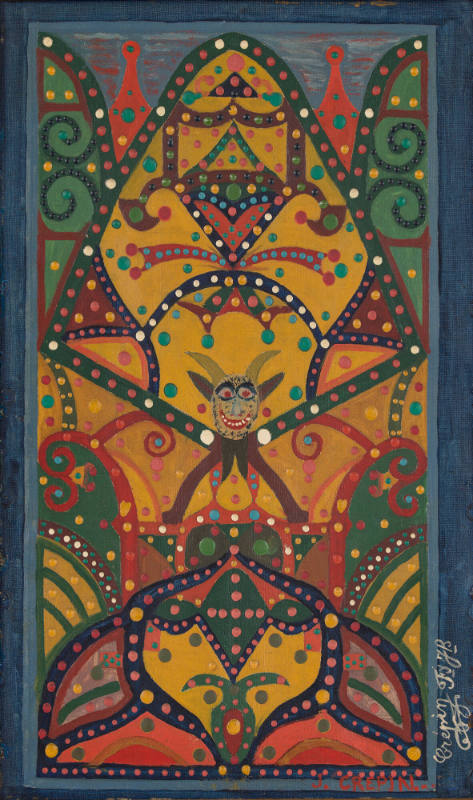
BiographyThe resplendent temples and palaces in Fleury-Joseph Crépin’s paintings are embellished with tiny pearls of paint—dimensional details that enhance the bright colors and captivating symmetry. The meticulously numbered and dated oil-on-canvas works are dreamlike in their dotted columns, domes, spires, friezes, and stairways. Employing a flattened perspective, Crépin further adorned these fantastic structures with stylized plants, animals, angelic beings, and human figures, some of which are incorporated into the architecture as ornamentation. Often, stars, the sun, and the moon appear overhead. They were all made in fulfillment of a spirit-guided mission with which he believed he was tasked: to create art that could end war and bring peace.Crépin was born in Hénin-Liétard in the Pas-de-Calais department in northern France in 1875. He later became a plumber. At the same time, he maintained a creative streak, having a passion for music and composing his own pieces. In the early 1930s, he first engaged with spiritualist practices. He met mediumistic artist Victor Simon and encountered automatic drawing, a trance-like process that would guide his own art practice. He found a place in the spiritualism movement as a healer and dowser. He started making art in late 1938, his early work inspired by the grid of a music score. In 1939, he set out to create what would be his central body of work: a series of three hundred paintings that, when completed, would bring about the end of World War II. He finished the first of these pieces on March 25, 1939. He worked daily on this quixotic goal, carefully using tools such as a ruler and compass to guide his compositions, pausing only for upheavals caused by the country’s occupation and the death of his wife. He finished the three-hundredth painting on May 7, 1945, just before the signing of the German surrender. It shows a butterfly—its wings are the flags of the Allies—soaring above two branches flourishing with flowers.
Amid a growing interest in self-taught creators and the formation of ideas about art brut, his work attracted the attention of Jean Dubuffet and André Breton, with whom he had an active correspondence. After his three-hundred-painting series, he began a planned forty-five “tableaux merveilleux” that would secure global peace. By the time of his death in 1948, he had completed all but two.
Allison C. Meier, 2025
Text written as part of “Rethinking Biography,” an initiative supported by the Institute of Museum and Library Services (IMLS).
Loading ...