

Josef Karl Rädler
(1844–1917)
BornFalkenau (now Sokolov), Bohemia, Austria-Hungary (now Czech Republic)
ActiveMauer-Öhling, Austria
ActiveVienna, Austria
DiedMauer-Öhling, Mauer bei Amstetten, Austria
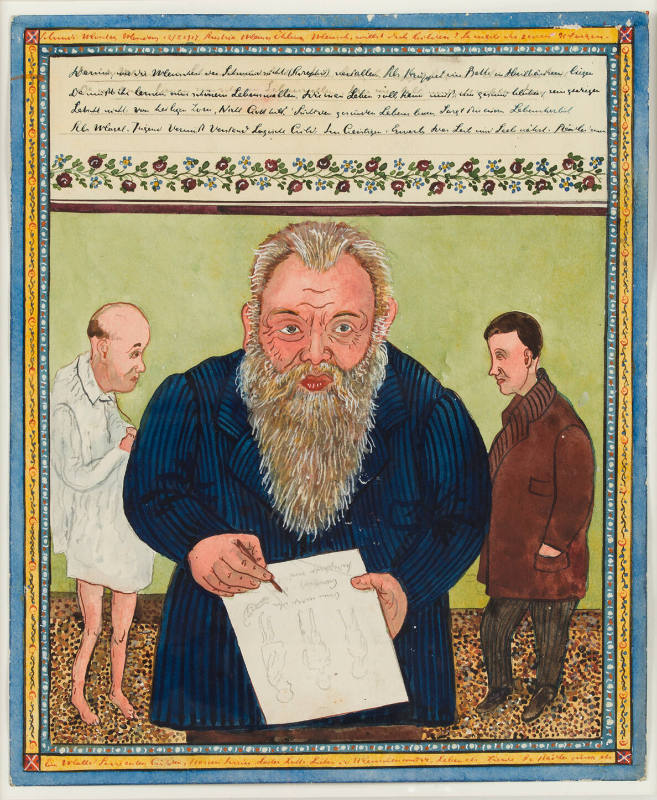
BiographyJosef Karl Rädler created hundreds of watercolors expressing his views as a patient in a psychiatric hospital at the turn of the twentieth century. His vibrant paintings are enhanced with gouache, pencil, colored inks, tempera, and other materials, giving them a textural depth. Portraits of fellow patients and scenes of daily life in and around the hospital are annotated with text, which sometimes erodes into illegibility. Calling himself “a laughing philosopher,” Rädler offered his thoughts on current affairs, pacifism, and how to live a healthy life. He covered both sides of the sheet, adding florid framing reminiscent of illuminated manuscripts. One, dated 1917, has on one side a possible self-portrait and advises, “Man, Do You Want to Educate Yourself? Think Up a Motto Every Morning.” Its central bearded figure holds a drawing that resembles the finished composition and is flanked by one man in a nightgown and another in winter attire. The reverse features a crowd of people depicted with meticulous realism but with an uncanny perspective in their various sizes and configurations.Rädler was born in 1844 in Falkenau, Bohemia (today Sokolov in the Czech Republic). In his early twenties, he moved to Vienna, where he became a successful porcelain painter. He co-founded the Artistische Atelier für Porzellanmalerei Rädler & Pilz, a manufactory that had branches throughout the world. This work in the decorative arts likely inspired the intricacies of his later watercolors. After displaying increasingly erratic behavior, he was committed in 1893, first to state psychiatric hospitals in the Vienna area. He was transferred in 1905 to a new hospital in Mauer-Öhling, in rural Lower Austria, designed to be a modern facility with open spaces, activities, and gatherings for its patients. It is believed that Rädler started painting his watercolors around 1897, although only after arriving at Mauer-Öhling did he expand his subject matter from mostly birds to intimate scenes of the hospital.
His work didn’t emerge until decades following his death, in 1917; in the mid-1960s employees saved it from being discarded during hospital renovations. In 1972, selections were given to the psychiatrist Léo Navratil, who had led the formation of an art center for psychiatric patients in the Maria Gugging Psychiatric Clinic on the outskirts of Vienna. Rädler’s work was in a touring show in Lower Austria in the 1980s, but it was a 1994 exhibition at the Niederösterreichischen Landesmuseum in St. Pölten, accompanied by a publication by Navratil, that gained it an international profile.
Allison C. Meier, 2025
Text written as part of “Rethinking Biography,” an initiative supported by the Institute of Museum and Library Services (IMLS).