From his embellished blue 1967 Cadillac to his bejeweled dentures, Loy Bowlin made everything in his life dazzle. This included his small house in McComb, Mississippi, which he called the Beautiful Holy Jewel Home, every inch of which was painted and patterned with glitter, construction-paper cutouts, and Christmas ornaments hung from the ceiling year-round. The sparkling transformation of the ordinary objects in his day-to-day life, including his Western-style polyester outfits festooned as grandly as Hollywood Nudie suits, was part of his metamorphosis into the self-anointed Original Rhinestone Cowboy.
Locals got to know Bowlin as he drove around in his distinctive car—its hood crowned with a pair of longhorns—and danced, played his harmonica, and sold autographed photographs at area fairs and flea markets. (“The teeth are what really get people,” he once said.) Few likely knew that this boisterous persona was a response to a particularly low point. Born in 1909 in Franklin County, Mississippi, he grew up on a ranch and later had a hardscrabble life as a farmer. A divorce and a bout of depression made him feel isolated. As he related, “I was layin’ on my bedside just as lonesome as I could be. I was by myself and so lonesome the tears just come in my eyes. . . . I prayed and said, ‘Lord, give me something to make me happy.’” The answer came in a song, the 1975 Glen Campbell hit “Rhinestone Cowboy,” especially the lyrics “But I’m gonna be where the lights are shinin’ on me / Like a rhinestone cowboy.”
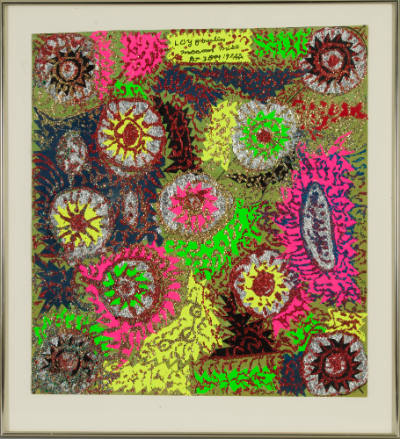
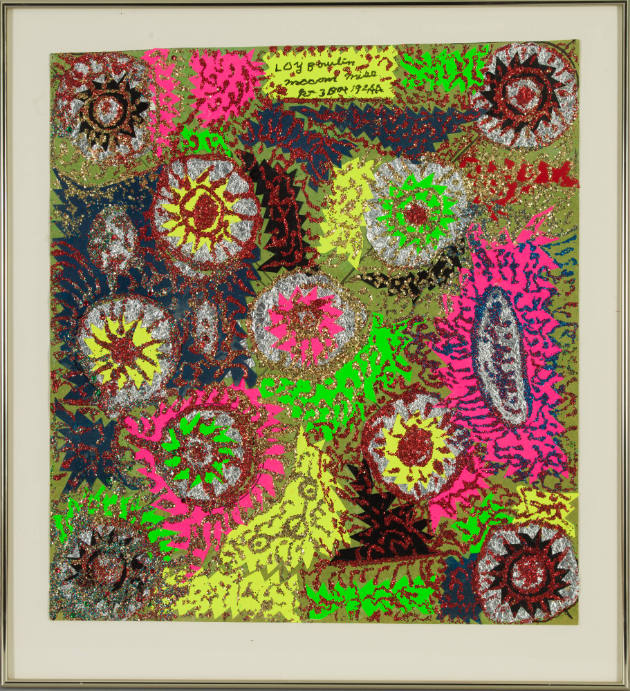
Sign painter Paul Maurer regularly helped Bowlin realize his dream by performing such tasks as painting portraits of Bowlin and magnolias—the state flower of Mississippi—on the suit jackets. In the mid-1980s, when his energy for traveling declined, Bowlin mostly spent time on his house and creating smaller works, including geometric patterns on paper with aluminum foil, markers, and, of course, glitter. When he died, in 1995, the future of his kaleidoscopic home was uncertain. It was saved from potential demolition by artist and collector Katy Emde, with the requirement that it be removed from the property, and was acquired by the Kohler Foundation in 1998. The entire house was disassembled and relocated to Sheboygan, Wisconsin, many miles from where it was first envisioned but still shining with Bowlin’s optimism that a few plastic rhinestones could bring light into the darkness.
Allison C. Meier, 2025
Text written as part of “Rethinking Biography,” an initiative supported by the Institute of Museum and Library Services (IMLS).