
Anthony Dominguez
(1960–2014)
BornFort Worth, Texas, United States
ActiveNew York, New York, United States
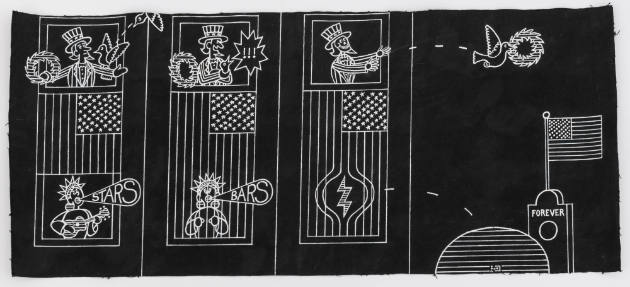
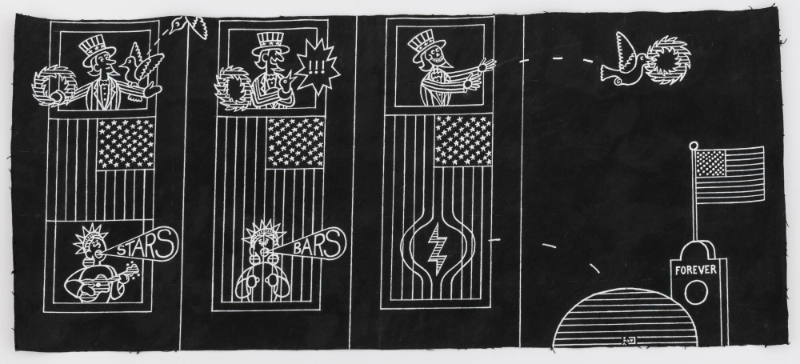
BiographyIn monochromatic black-and-white contrasts, Anthony Dominguez created art to grapple with struggles of life, death, and renewal in a capitalist society. Some early images joined by cryptic messages were printed with bleach applied with hypodermic syringes on black fabric scavenged in the Garment District—examples of materials he could find in his chosen nomadic life on the streets of New York. These small circular works feature emblem-like imagery, with trickster skeletons engaged in activities of daily life and symbols of transformation, including butterflies. Later he worked on a larger scale, still with his highly graphic style, sometimes reversing his palette to black on white or diverging further to accents in red, always conveying his incisive views on the ironies and reversals of existence in the contemporary world.Dominguez was born in Fort Worth, Texas, in 1960. His father was a commercial artist, and Dominguez had a childhood passion for art that he later nurtured in university classes, although he left before earning a degree and went to work as a sign painter. He moved to New York in the 1980s and found employment in graphic design. Around the early 1990s, he vacated his apartment and discarded everything he owned. He spent the rest of his life unhoused, finding sporadic shelter in abandoned spaces. The freedom he felt in being liberated from material obligations became a theme in the work that he constantly produced. As he declared in an artist’s statement, “We have to find our way the best we can. I just so happened to be lucky and realize what Christ was telling society about Exit The Fall.”
The jacket he wore covered with his handmade patches was noticed by Aarne and Tina Anton, leading to his first exhibition at Tina’s nonprofit Art on the Edge, which supported unhoused artists, and representation by Aarne’s American Primitive Gallery. He continued to evolve his practice, including creating flutes from plastic plumbing pipe, which inspired musical and lyrical notations in his art. He died by suicide in 2014. Most of his hundreds of works were signed with a stick figure opening a door adorned with a heart. As he explained in a 2002 article for the magazine Folk Art, “If you’re free from identity, you’re free from the constraints that society brings to bear on you. That way, you open yourself to how you see things. That’s why I use the door.”
Allison C. Meier, 2025
Text written as part of “Rethinking Biography,” an initiative supported by the Institute of Museum and Library Services (IMLS).