
Dwight Mackintosh
(1906–1999)
BornHayward, California, United States
DiedBerkeley, California, United States
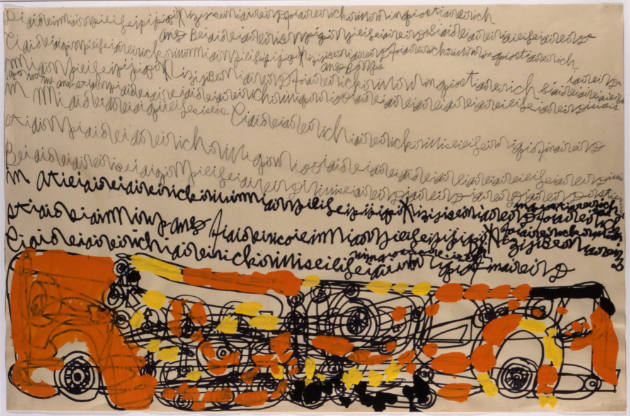
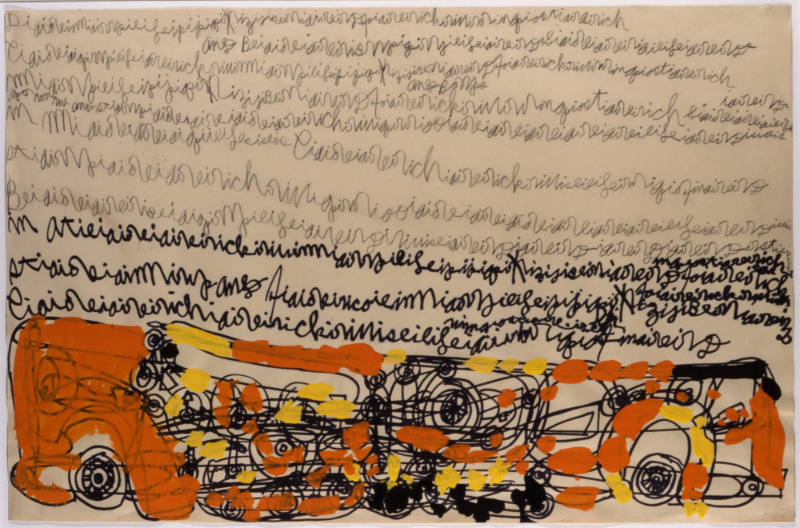
BiographyThe animated energy of Dwight Mackintosh’s drawings reveals X-ray-like images of a range of subjects, including people, cars, airplanes, animals, and landscapes. Interior mechanisms of vehicles are exposed and exaggerated, transparent body parts overlap one another in groups of nude figures. Some scenes reflect Mackintosh’s own experiences, such as the removal of his tonsils when he was a child. His works are often surrounded by indecipherable scrawled cursive text. The details have a quickness to them, overlaid in imperfect shades and shapes atop heavy, looping lines drawn in ink and felt-tip pen.
Mackintosh was born in Hayward, California, in 1906, at a time when treatment for mental disabilities was limited. He was institutionalized at sixteen, and he spent the next fifty-six years moving among various hospitals. In 1978, during a period of deinstitutionalization, he was released to the custody of his brother. Having shown an interest in art, Mackintosh came to the Creative Growth Art Center, in Oakland, California, in 1979, just five years after the nonprofit studio was founded to support artists with developmental, mental, and physical disabilities. Mackintosh was one of the first members of Creative Growth to gain international recognition.
Until his death in 1999, Mackintosh worked daily at Creative Growth, creating thousands of drawings. He expanded over the years from lines of male figures to diverse subjects ranging from angels to musical instruments, using increasingly intricate and lavish linework. With the support of the Creative Growth staff, he also experimented with media such as clay as a surface for his calligraphic drawings. A 1992–93 touring solo show was organized by the Collection de l’Art Brut in Lausanne, Switzerland, in collaboration with Ricco/Maresca Gallery in New York. In 1994, Mackintosh sketched a poster for the Lollapalooza music festival.
Allison C. Meier, 2025
Text written as part of “Rethinking Biography,” an initiative supported by the Institute of Museum and Library Services (IMLS)