
Miguel García Vivancos
(1895–1972)
BornMazarrón, Spain
ActiveBarcelona, Spain
ActiveFrance
DiedCórdoba, Spain
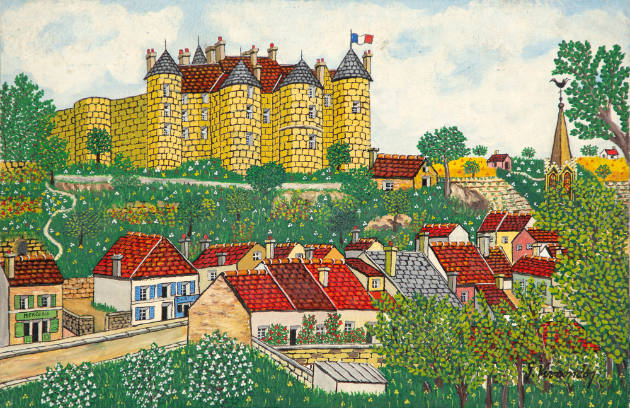
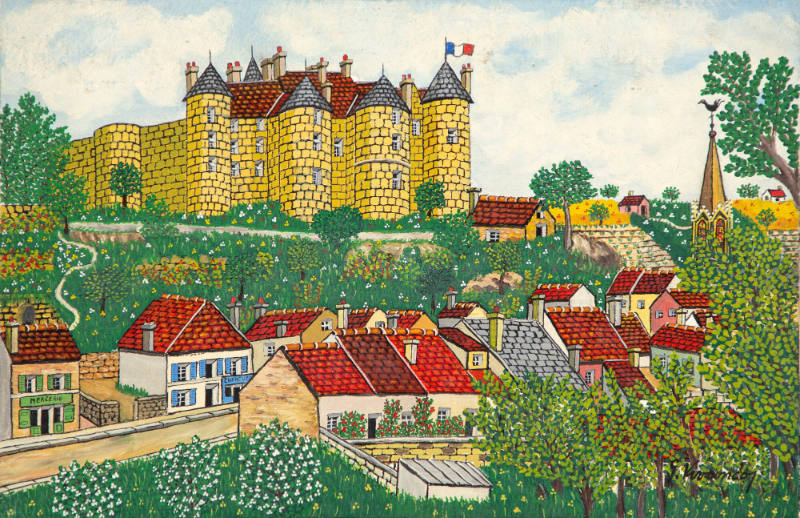
BiographyMiguel García Vivancos painted tranquil scenes of rural and urban life in the mid-twentieth century, rendered in vivid color and incredible detail, from the stonework on a Gothic church to the lace covering a table in a window. In these landscapes, each blade of grass is delicately depicted, and the lines of the buildings have a meticulous precision. Yet the flat and sometimes skewed perspectives give his pieces an uncanny quality: pots of flowers and plants loom large over towns, and the streets are often strangely devoid of people.García Vivancos was born in 1895 in Mazarrón, Spain, and later moved to Barcelona, where he worked at various odd industrial jobs. He also became involved in the anarchist National Labor Confederation and helped to start the Los Solidarios group. During the Spanish Civil War, he served as an officer in the Spanish Republican Army. Following the defeat of the Republic, he fled to France, then under German occupation. Initially held in a concentration camp, he was later freed and supported the French Resistance. After the end of World War II, he settled in Paris and started to paint, first on silk handkerchiefs, to make souvenirs for soldiers. He expanded to canvases of rural scenes in Spanish and French villages as well as urban settings of Paris, becoming one of Spain’s best-known “naive” painters of the mid-twentieth century.
Pablo Picasso was a pivotal early proponent of García Vivancos’s works after the two met in 1947. André Breton, another of his advocates, supported the presentation of his paintings in 1950 at Galerie Mirador in Paris. In his 1965 edition of Le surréalisme et la peinture, Breton referred to García Vivancos’s art as “an indiscernible lesson in candor and strength.” Late in life, as his health was failing, García Vivancos returned to Spain. He died in Córdoba in 1972.
Allison C. Meier, 2025
Text written as part of “Rethinking Biography,” an initiative supported by the Institute of Museum and Library Services (IMLS).