
Patrick J. Sullivan
(1894–1967)
BornBraddock, Pennsylvania, United States
DiedWheeling, West Virginia, United States
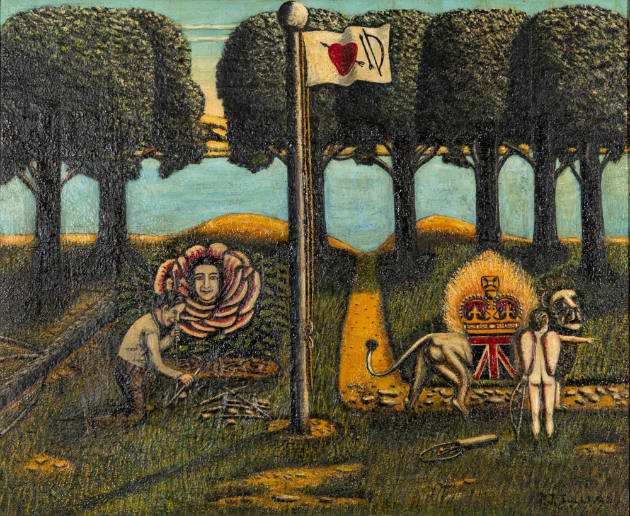
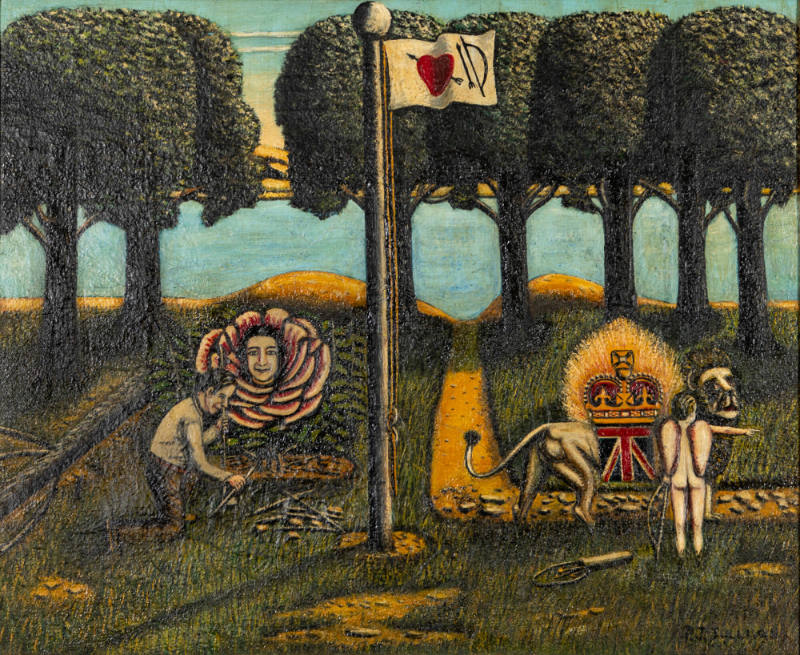
BiographyPatrick J. Sullivan’s allegorical landscapes are dense with symbolism expressing the complex interiority of humanity. An Historic Event (1937) reflects on the tension between love and duty through the romance and subsequent abdication of King Edward VIII and Wallis Simpson. Dividing the canvas is a flagpole holding aloft a heart pierced by an arrow on its flag. Cupid is below, directing a lion carrying a crown on his Union Jack–draped back to leave; on the other side, a man tends to a rose from which a woman’s face blooms. A Rendezvous with The Soul (1938), set in a crepuscular forest of autumn leaves, is a meditation on the end of life. Human bones are strewn on the ground, and a man looks at a central figure presenting an hourglass. Sullivan worked slowly and methodically on these nuanced works, using sandpaper to enhance the sculptural texture of the thick layers of oil paint; he completed about three paintings a year and thus created a limited body of work.Born in 1894 in Braddock, Pennsylvania, to Irish immigrants, Sullivan was the youngest of twelve children. After his father died when he was two, his mother, unable to care for her large family, placed him in an orphanage. In 1911, they reunited and moved to Wheeling, West Virginia. He served in the U.S. Army during World War I and held various jobs, including in a steel mill and as a house painter. He married in 1920 and had two daughters. Alongside house painting, he experimented with painting on found materials, such as a tea towel and a window blind. Only with the subsidence of the Great Depression did he dedicate himself to a personal practice, using a bedroom corner as a studio.
He sent his first original painting on canvas—Man’s Procrastinating Pastime (1936)—to the 1937 Society of Independent Artists show in New York. It was noticed by the collector Sidney Janis, who brought him to the attention of the Museum of Modern Art, which included him in the 1938 exhibition Masters of Popular Painting: Modern Primitives of Europe and America. Sullivan was quoted in the catalogue: “To make people think is my main reason for painting.” Despite the institutional recognition, he was not able to support himself as an artist and ultimately returned to other work. He died in 1967.
Allison C. Meier, 2025
Text written as part of “Rethinking Biography,” an initiative supported by the Institute of Museum and Library Services (IMLS).
Loading ...