Gaston Chaissac
(1910–1964)
BornAvallon, France
DiedLa Roche-sur-Yon, France
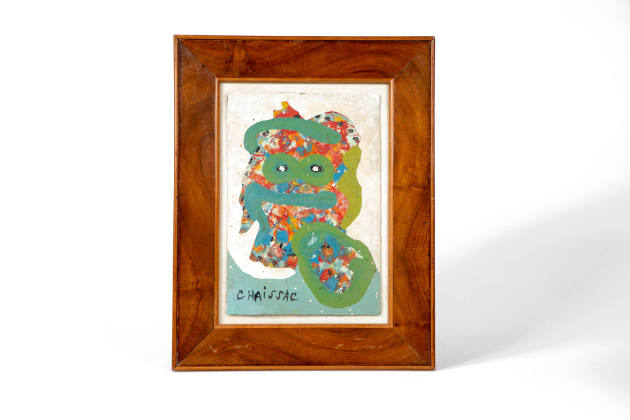
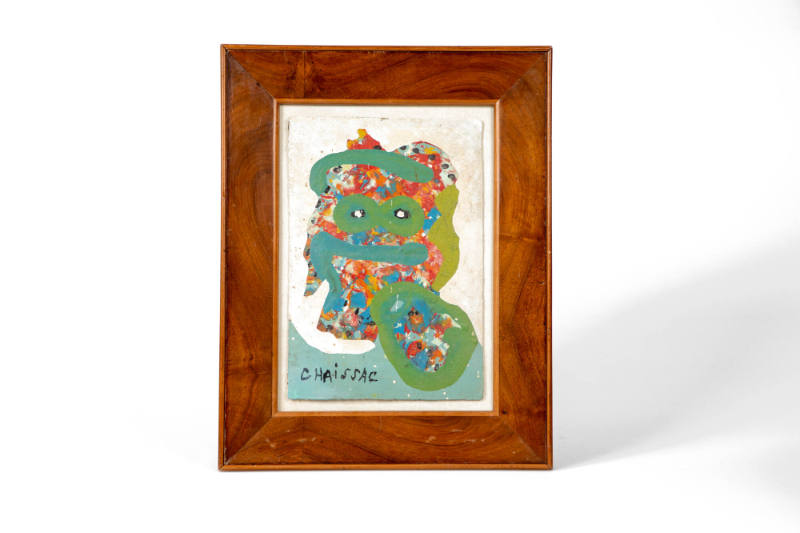
BiographyAlthough isolated from cultural urban centers, Gaston Chaissac was deeply engaged with the art world through his extensive correspondence with critics, journalists, and artists, such as Jean Dubuffet, Albert Gleizes, and Raymond Queneau. Inspired by modern painting, Chaissac worked intuitively, using an automatic drawing process. In a 1947 letter to Pablo Picasso, he wrote “I’m a Picasso in clogs, Picasso’s student, student by correspondence course.” Calling his art “modern rustic painting,” he often used objects found in the French countryside for his surfaces, such as scraps of wallpaper, straw brooms, and planks of wood for totemic sculptures. The black contours of his paintings contain puzzle-like colored shapes, some marked with exuberant faces.Chaissac was born in 1910 in Avallon in Burgundy, France. In 1937, when he was living in Paris and working in a shoe repair business, his neighbors, the artists Jeanne Kosnick-Kloss and Otto Freundlich, encouraged him to paint. He had his first solo show in 1938. After he married his wife, Camille, he lived in various parts of France where she worked as a schoolteacher, including in the Vendée department. Along with his paintings, collages, and assemblages, he wrote poetry and prose.
In the 1960s, Chaissac’s work was embraced by the CoBrA avant-garde art group for its qualities of spontaneity and authenticity. He died in 1964; his first retrospective was held in 1969 at the Musée d’Art Moderne et Contemporain des Sables d’Olonne. This museum now holds the largest public collection of his work and also houses the Centre d’Études Gaston Chaissac reference resource center.
Allison C. Meier, 2025
Text written as part of “Rethinking Biography,” an initiative supported by the Institute of Museum and Library Services (IMLS).