
Pavel Leonov
(1920–2011)
BornOrel, Orlovskai︠a︡ oblastʹ, Russia
ActiveMekhovitsy, Ivanovo, Russia
DiedMekhovitsy, Ivanovo, Russia
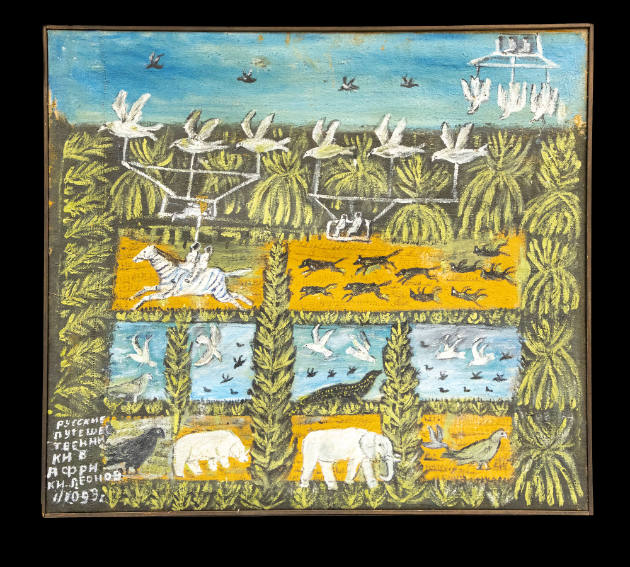
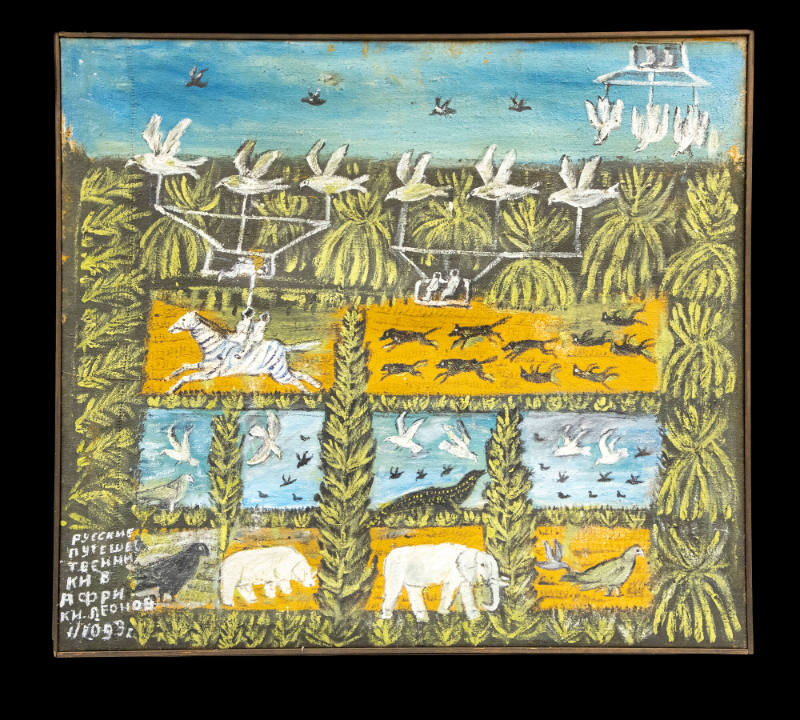
BiographyNature and modernity exist harmoniously in Pavel Leonov’s paintings. Birds mingle with helicopters, and buses and cars share space with horses and bears; such groups are organized in horizontal and vertical segments that Leonov called “television sets.” Often working at a large scale and using unstretched, roughly cut canvas, he created tapestry-like paintings, often based on memories or highly fictional interpretations of historical and religious events. The architectural structure of his works, in which borders are formed by trees or patterns of butterflies and leaves, evokes theater prosceniums. Although settings such as the circus and distant locales such as Africa appear—frequently with a dash of the fantastic, such as people soaring through the sky on contraptions held aloft by birds—his most recurrent subject is the Russian village. Despite Leonov’s firsthand experience with the hardships of rural life, his representations are highly idealized and imbued with a festive spirit.Born in 1920 in the Oryol region of western Russia, Leonov left home at sixteen, fleeing an abusive family situation. His tendency to clash with authority—what he described as his “struggle against injustice”—resulted in him spending much of his time in labor camps from the mid-1930s to 1955. After his release, he worked at various odd jobs, including sign painting, farming, metalworking, and woodcutting. While working in a tractor factory, he decided to learn to paint. In the 1960s, he took correspondence courses through ZNUI (the People’s Free University of the Arts by Correspondence, established to support amateur artists). This organization was part of a movement to foster Russian naïve art in the wake of Joseph Stalin’s death, following decades during which only socialist realism had been considered acceptable in the Soviet Union. Leonov was especially influenced by the ZNUI teachings of nonconformist artist Mikhail Roginsky.
Leonov’s first exhibition in Moscow was in 1970, and by the late 1980s his art was being presented abroad. He became one of the most prominent Russian self-taught artists of the twentieth century. Until his death in 2011, Leonov continued to paint from his humble home in the rural village of Mekhovitsy in the Ivanovo region.
Allison C. Meier, 2025
Text written as part of “Rethinking Biography,” an initiative supported by the Institute of Museum and Library Services (IMLS).