
Adolf Wölfli
(1864–1930)
BornBern, Switzerland
DiedBern, Switzerland
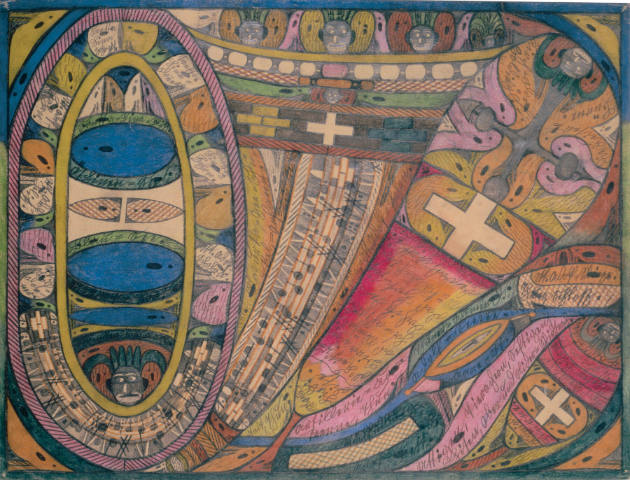
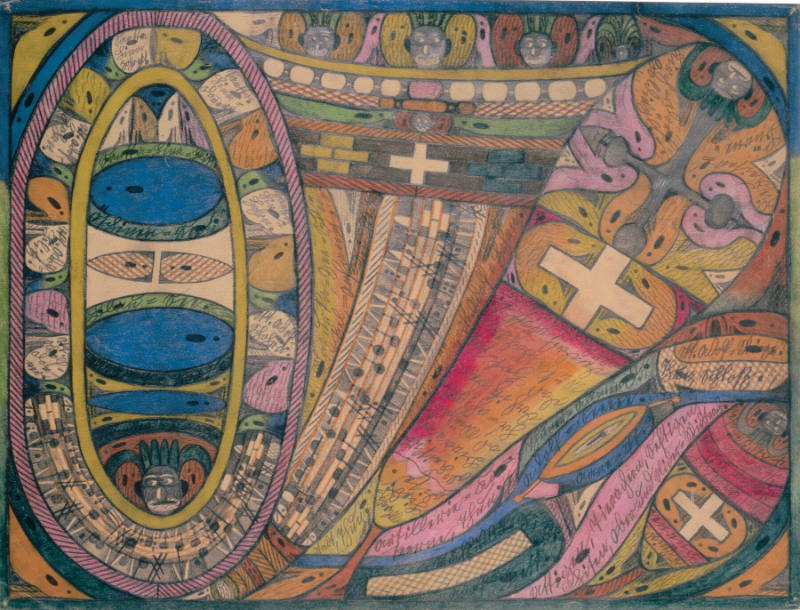
BiographyAdolf Wölfli’s body of work is incredibly rich, yet every piece is unmistakably part of Wölfli’s self-mythologization, as recalls his 25,000-page, highly fictionalized autobiography. The hallucinatory mix of text and images, in which architecture, animals, geometric patterns, musical notation, maps, calculations, and ornamental borders are intricately entwined, is as lavish as an illuminated manuscript. Negative space is nonexistent. Wölfli was born in 1864 near Bern, Switzerland. He was orphaned at a young age, and his childhood was marked by abuse in foster homes and indentured labor. He served briefly in the military and worked as a farmhand before being sentenced to a series of prison terms. In 1895, he was committed to the Waldau Clinic, a psychiatric hospital outside of Bern, where he stayed until his death in 1930. His earliest known drawings date to 1904; he started his colossal autobiographical piece, chronicling his transformation into “Saint-Adolf-Giant-Creation,” in 1908. Its sprawling prose, drawings, collages, musical compositions, poetry, and phonetic-numeral systems ultimately filled forty-five hand-bound volumes. At the same time, he made individual works—“bread art,” he called it—that he sold or traded to support his acquisition of art materials. His focus was always his magnum opus, and he devoted the last two years of his life to its “Funeral March,” composed with a rhyming phonetic structure rather than musical signs and authored by his alter ego, “St. Adolf II Algebrator, Major-Commander and Music-Director, Giant-Theater-Director, Almighty-Steamship-Captain, and Dr. of Art and Science, Director of the Algebra and Geography-Books-Fabrication and Hunter-General. Inventor of 160 self-made inventions, highly valuable and patented, each of them, by the Russian Czar, and glorious victor of numerous, enormous gigantic battles.”
His prolific work drew wider attention after Dr. Walter Morganthaler, a Waldau Clinic psychiatrist, published the 1921 study Ein Geisteskranker als Künstler (A Mental Patient as Artist), in which he observed that Wölfli “thinks with his pencil. It is often the gesture that provokes his thinking.” Wölfli was posthumously rediscovered by proponents of art brut such as Jean Dubuffet. Much of his work is now preserved at the Adolf Wölfli Foundation in Bern.
Allison C. Meier, 2025
Text written as part of “Rethinking Biography,” an initiative supported by the Institute of Museum and Library Services (IMLS).