
Daniel E. Rohrig
(1911–1969)
BornHarmony, Indiana, United States
DiedPortland, Indiana, United States
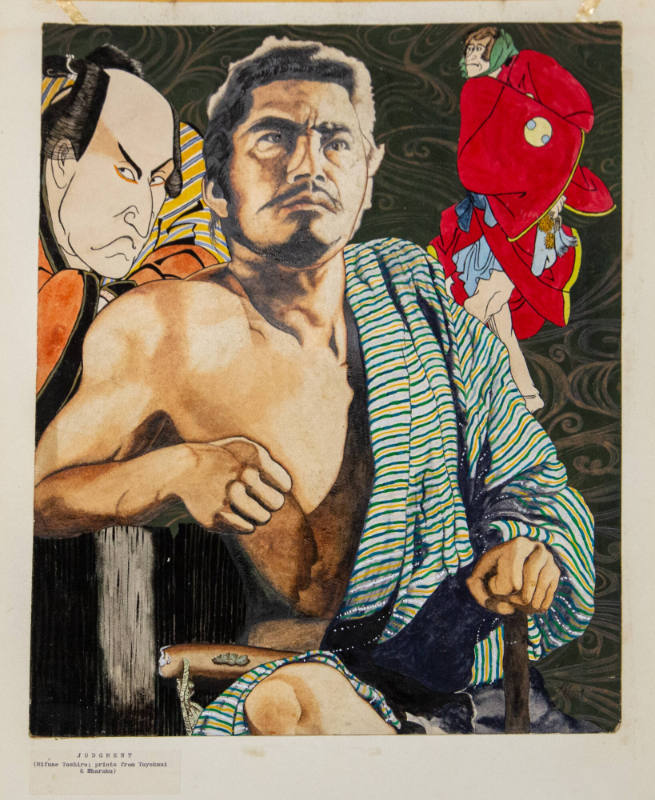
BiographyIn a highly graphic style, Daniel E. Rohrig borrowed imagery from centuries of Japanese culture. His mixed-media works on paper, usually involving gouache and ink, juxtapose styles ranging from the dramatic realism of postwar film posters to the bold, flat lines and color of ukiyo-e woodblock prints that were popular from the seventeenth to the nineteenth century. Figures from folklore and military history are joined with twentieth-century Japanese movie stars. He annotated most pieces with a typewritten label, noting the actor and prints that inspired it as he made thematic connections across time. Bandit (1957) pairs a vivid depiction of actor Toshiro Mifune as his bandit character in Akira Kurosawa’s Rashomon (1950) with a woodblock-style illustration of kabuki actor Ōtani Oniji III in a henchman role. Ancestral Counsel (1957) has a similar pairing of actor Tatsuya Mihashi in a military uniform—possibly for his part in The Burmese Harp (1956), which confronted World War II losses from the perspective of Japanese soldiers—with a skeletal figure based on a print from Katsushika Hokusai’s 1830s One Hundred Ghost Tales series.Daniel Emil Arthur Rohrig (also known as Daniel Rohrig, Don Rohrig, and Don E. Rohrig) was born in Harmony, Indiana, in 1911. He left in 1930 for Oklahoma to work in the zinc mines. In 1941, while living in San Bernardino, California, and working as a fruit-picking foreman, he was drafted into the U.S. Army. His World War II service included time in the Adjutant General’s Department administrative corps. After 1945, he worked in the 4th Replacement Depot in Leyte, Philippines, as a company clerk. For the rest of his career, he was a purser in the Military Sea Transport System, managing administrative work on military ships, a time that overlapped with the American occupation of Japan. It is probable that his many voyages to military bases in Japan fostered a deep passion for the country’s culture, and the long months at sea gave him time to immerse himself in his work.
He created more than seventy known works and is not known to have shared them publicly. Following his death in 1969 in Portland, Indiana, his niece inherited his art. The portfolios were acquired by a family friend in 1995. Through the art dealer Marion Harris, several pieces were sold with Rago Auctions in 2018 and then presented at the Outsider Art Fair in New York in 2019.
Allison C. Meier and Valérie Rousseau, 2025
Text written as part of “Rethinking Biography,” an initiative supported by the Institute of Museum and Library Services (IMLS).