
Richard Saholt
(1924–2014)
BornMinneapolis, Minnesota, United States
DiedMinneapolis, Minnesota, United States
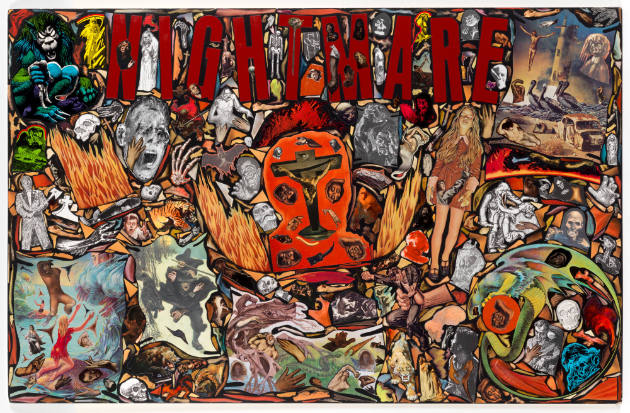
BiographyRichard Saholt grappled with the hellish terror of the world; in his collages he remixed blaring headlines and searing images of modern horror and violence from magazines, tabloids, and newspapers. Working on themes such as the stigma of mental illness, the brutality of war, and death, Saholt dedicated hours to finding fitting images to include in these anguished cacophonies. The collages on cardboard, as well as his dense scrapbooks, also visualize his experiences of daily life with schizophrenia. Among them, THE CHEMISTRY OF MADNESS turns a blank photo album into a chronicle of coming to terms with his inner turmoil; it is composed of articles on schizophrenia and hypoglycemia augmented with collage and writing, such as his annotation of the term for his illness as “a word often spoken in whispers.”Saholt spent much of his life in Minneapolis, where he was born in 1924. An abusive childhood was compounded by his struggles with undiagnosed learning disabilities and a speech impediment. He enlisted in the U.S. Army in 1942, joining the 85th Mountain Ski Troop Division that fought in the Italian Alps during World War II. He returned home with back and leg injuries and was psychologically traumatized. His earliest collages were small pieces made to express the rage at what he experienced as the military’s failure to disclose his schizophrenia diagnosis on enlistment and the subsequent neglect by the Veterans Administration. Over time, he worked on a larger scale. “I can make people see and understand things they never could before,” he told the Minnesota Star Tribune in 2001. “So in a way, my mental illness has been a gift. Without it, I wouldn’t have amounted to a row of beans. I would have been a total zero.”
An essential supporter was his wife, Doris, whom he met while taking singing lessons to improve his stutter and married in 1952. He achieved recognition for his work by the 1980s, starting with inclusion in a 1981 group show of artists with disabilities in Washington, D.C., organized by the Sister Kenny Institute of Minneapolis rehabilitation center. Saholt died in 2014. The American Folk Art Museum holds a large collection of works by Richard Saholt and extensive related materials donated by the art critic Michael Bonesteel.
Allison C. Meier, 2025
Text written as part of “Rethinking Biography,” an initiative supported by the Institute of Museum and Library Services (IMLS).