James Lloyd
(1905–1974)
BornAlsager, England
ActiveSkirpenbeck, England
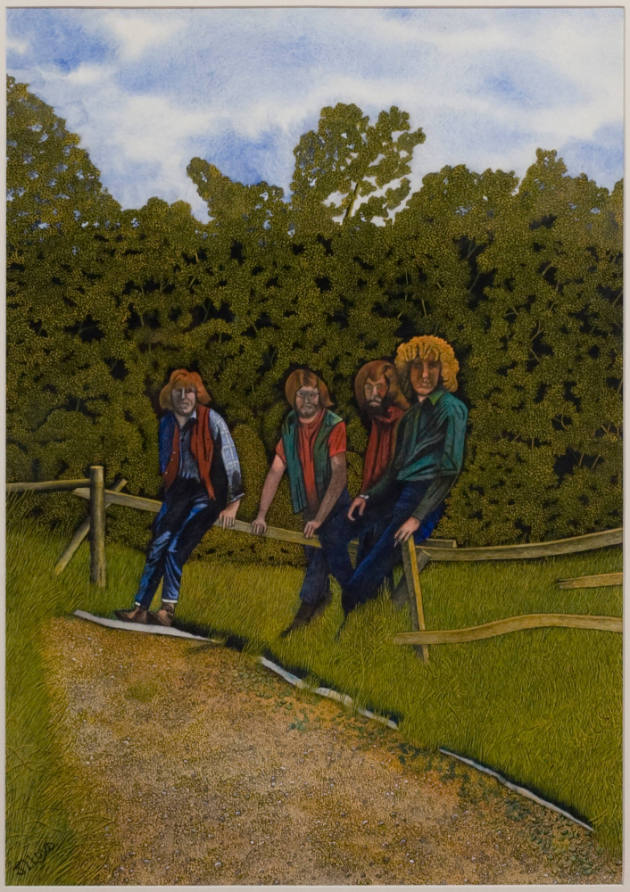
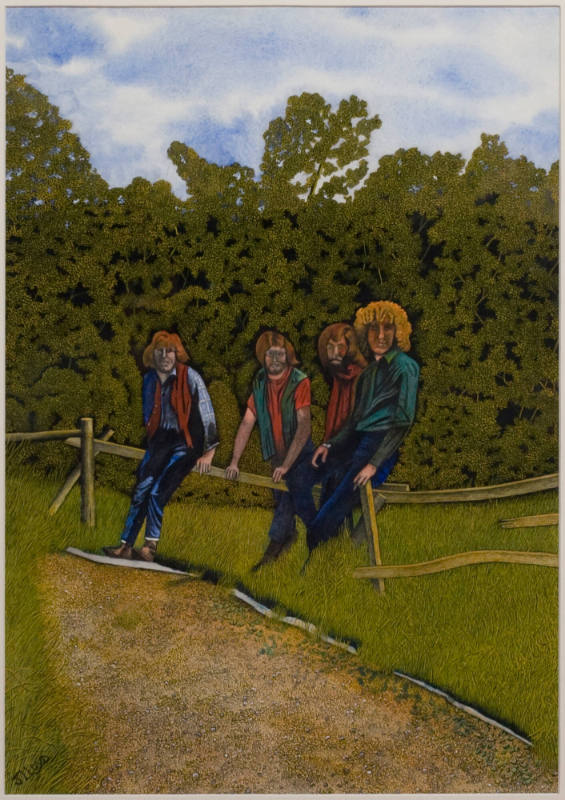
BiographyJames Lloyd’s close observation of English country life was expressed through a unique technique reminiscent of pointillism. As he studied reproductions of works by English artists such as J. M. W. Turner and John Constable—particularly letterpress printings in farming journals—Lloyd noticed that each was composed of numerous colored dots. Inspired, he used a brush with just a few bristles to precisely depict the fur on a rabbit, the texture of a country lane, and the verdant character of a landscape under cloudy skies. Alongside these bucolic scenes, Lloyd also avidly painted celebrities from pop culture, including portraits of actresses such as Honor Blackman and British rock bands such as the Beatles and the Who. He would spend hours on a single work, thousands of tiny dashes of color giving his art a dreamlike quality, even as he sought to create a sense of realism.Frederick James Lloyd was born in 1905 and grew up on his family’s farm in Alsager in Cheshire, England. He created drawings with black ink as a child but never pursued art professionally. Instead, he held various jobs as a farm worker, bus conductor, stoker, lamplighter, and police officer. He married in 1931; the couple separated when Lloyd returned from his army service. He soon remarried, moving to the village of Skirpenbeck in Yorkshire, where his family grew to include nine children, one of whom died young. According to family accounts, Lloyd started painting after the birth of his first child. Unable to afford Christmas cards, he decided to make some himself. Using the kitchen table as his studio, he usually painted in the evenings after a day’s work as a cowman and later at a plastics factory.
In 1957, Lloyd’s second wife, Nancy, brought his work to the attention of the York Museum’s curator, the art critic Herbert Read. Read’s interest led to a 1958 exhibition at Arthur Jeffress Gallery in London, followed by shows at Portal Gallery in the early 1960s and a 1964 BBC documentary, The Dotty World of James Lloyd. Despite having no acting experience, Lloyd subsequently played Henri Rousseau in director Ken Russell’s television film on the French self-taught painter. Before he died in 1974, Lloyd had become a full-time artist, although he still preferred to paint at the kitchen table, surrounded by the bustle of the household around him.
Allison C. Meier, 2025
Text written as part of “Rethinking Biography,” an initiative supported by the Institute of Museum and Library Services (IMLS).
Loading ...