
Bill Traylor
(c. 1853–1949)
BornAlabama
ActiveMontgomery, Alabama
DiedMontgomery, Alabama
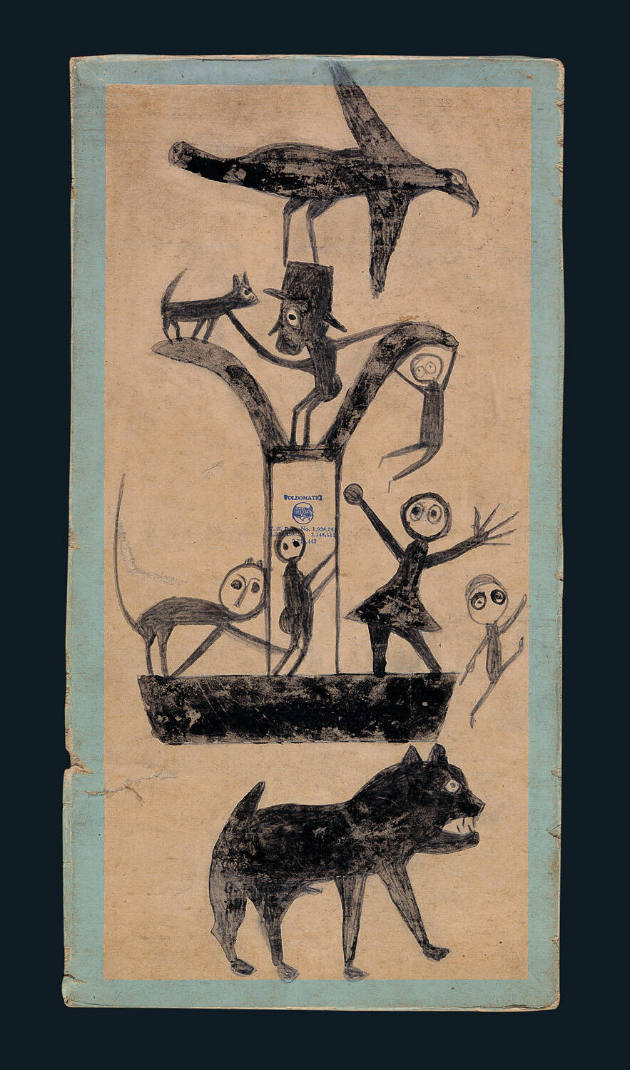
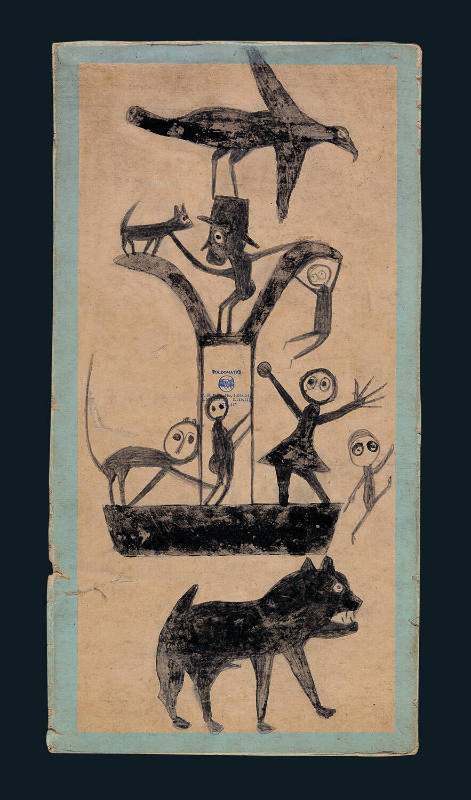
BiographyThe lively silhouettes of people and animals in Bill Traylor’s work represent some of the most prolific artistic statements created by someone born into slavery. Like many of his generation in the American South, he experienced both the oppression of a plantation and the emergence of a vibrant Black urban life in the twentieth century. Usually using pieces of cardboard as surfaces, he distilled these complex narratives into solidly colored figures in blue, red, yellow, and black poster paint. His repeating characters and themes, from sharp-toothed dogs to exuberant top-hat-wearing figures, take on an allegorical feel as they appear across numerous works. Violent undertones are evoked by snakes and flailing figures, recalling the struggle for survival from Emancipation to Reconstruction to the discrimination of the Jim Crow era. Yet frequently these are images of joy and pride, as he depicted the social, leisure, and work activities of Montgomery, Alabama, in the 1930s.Traylor was born around 1853 in rural Dallas County, Alabama, and grew up on a plantation, where, like many other enslaved children, he was denied an education. He continued to work with his family as a plantation laborer after the Civil War and then as a sharecropper and tenant farmer. Most of his children moved north during the Great Migration. He arrived in Montgomery in the late 1930s and began creating art in his mid-eighties around 1939, a time when it was still bold for a Black man to make such direct work confronting the racial divisions in society. From his vantage point on Montgomery’s Monroe Avenue (today Monroe Street), he took inspiration from the everyday life around him, as well as his memories.
His work soon drew the attention of collectors, including the artist Charles Shannon, leading to a small 1940 exhibition at Montgomery’s New South art center. Most of his acclaim would come following his death in 1949, especially after he was featured in the traveling exhibition Black Folk Art in America, 1930–1980 organized in 1982 by the Corcoran Gallery of Art in Washington, D.C. Despite the meteoric rise of his name in the decades that followed, questions remain over Traylor’s intentions, such as the specific symbolism of his figures, as he was not formally interviewed. In 2018, his-long unmarked grave on the Montgomery outskirts was finally recognized with a monument, its epitaph stating, “Through His Art He Lives On.”
Allison C. Meier, 2025
Text written as part of “Rethinking Biography,” an initiative supported by the Institute of Museum and Library Services (IMLS).
Loading ...