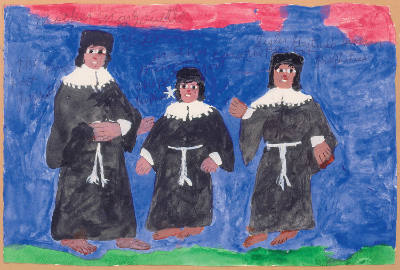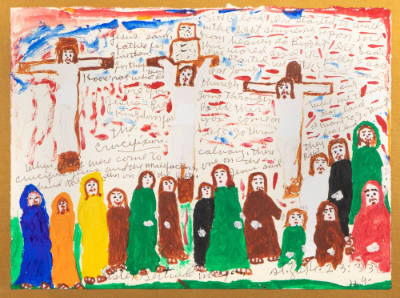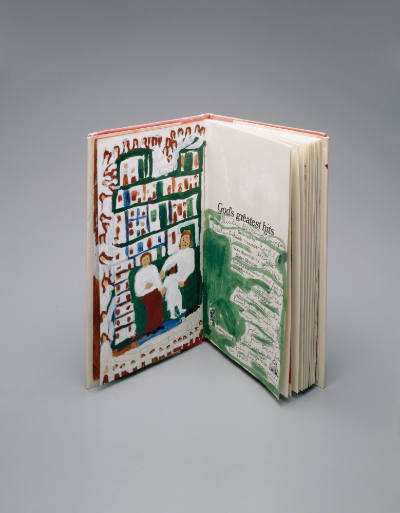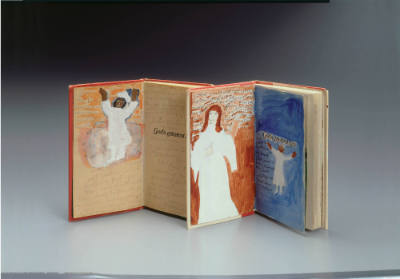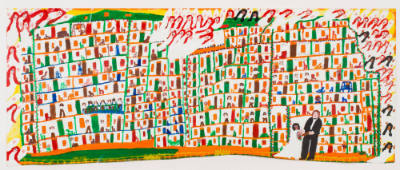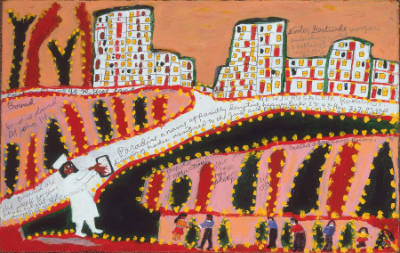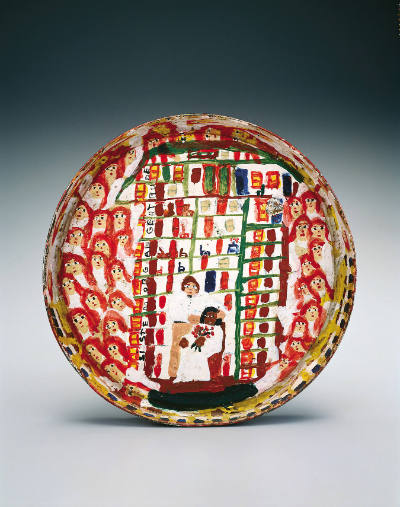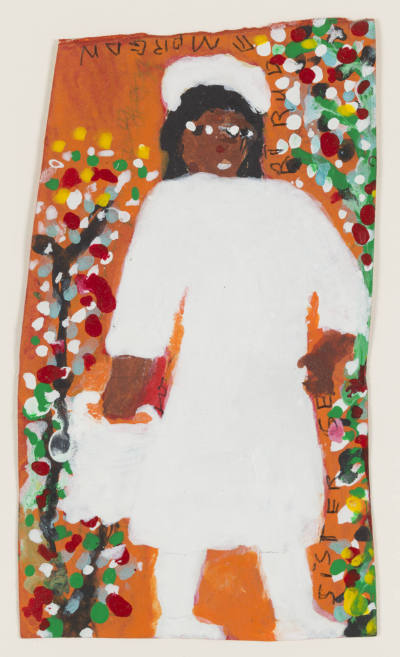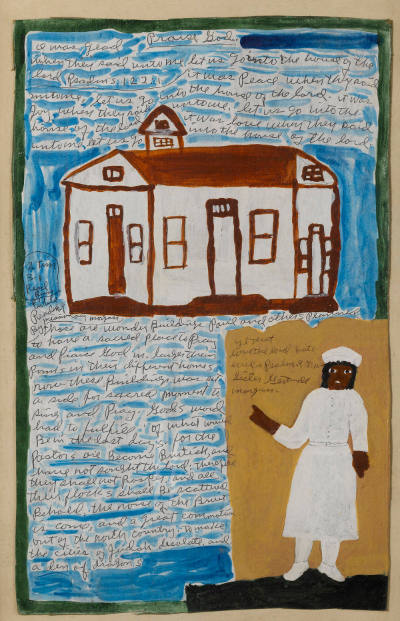

In Sister Gertrude Morgan’s works, a woman often appears attired all in white, much as Morgan dressed after 1957, when she anointed herself the Bride of Christ. Her hundreds of vibrant paintings were one part of her lifetime commitment to an evangelistic mission; she employed metal lids and Styrofoam trays as surfaces alongside paper and cardboard, using various methods to spread the gospel. She also sang and played guitar and tambourine as a street preacher, rhythmically repeating words like “power” and “hallelujah” to passersby in the French Quarter of New Orleans. In her visual art she likewise returned to themes over and over, particularly in the late 1960s, when she depicted vivid scenes of New Jerusalem, from the Book of Revelation, from where the dead would rise to a heavenly new world for the righteous.
Born in 1900 in Lafayette, Alabama, Morgan grew up in the Southern Baptist Church. She was in her thirties when a series of revelations compelled her to leave her family for New Orleans, which she called the “headquarters of sin.” As she wrote in a 1970 poem accompanying a portrait of herself holding a guitar, “My heavenly father called me in 1934 . . . I’ll make thee as a signet for I have chosen thee. Go ye into yonders world and sing with a loud voice for you are a chosen vessel . . .” She helped organize a chapel and center for children as she became a regular presence on the streets, where she gave captivating stream-of-consciousness sermons. In the 1950s, she started painting, featuring scriptural text in her compositions. She came to broader recognition through the New Orleans gallery owner E. Lorenz Borenstein, who noticed her preaching with a paper megaphone in hand; he began exhibiting her work in the early 1960s, and he also recorded her chants and songs.
Morgan always avowed that she was divinely guided. In 1973, she told Interview magazine, “Just be sure and give Jesus credit for what I do. He’s the one that deserves all the praise. He’s the one that made me do it.” She released a gospel album in 1970—Let’s Make a Record—accompanying herself on the tambourine. In 1974, she stopped creating art and focused instead on poetry. She died in 1980 and was interred simply in a potter’s field.
Allison C. Meier, 2025
Text written as part of “Rethinking Biography,” an initiative supported by the Institute of Museum and Library Services (IMLS).