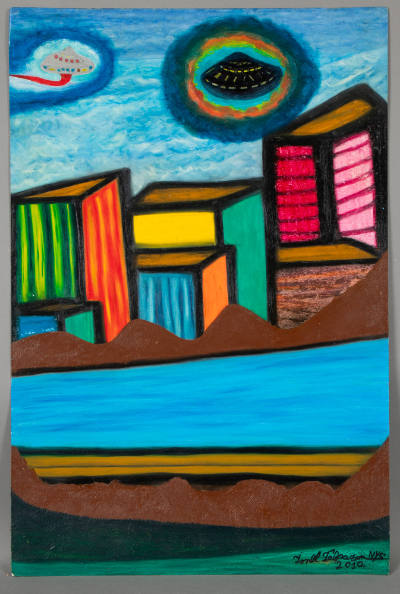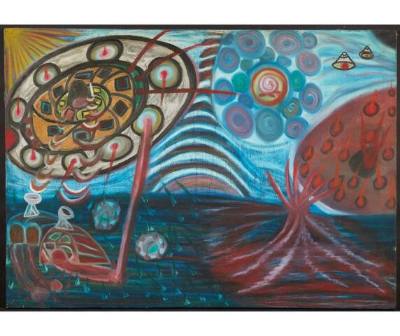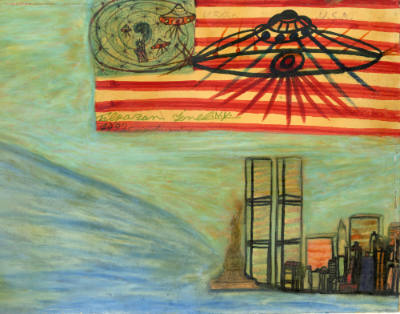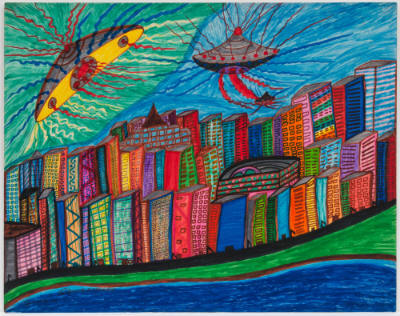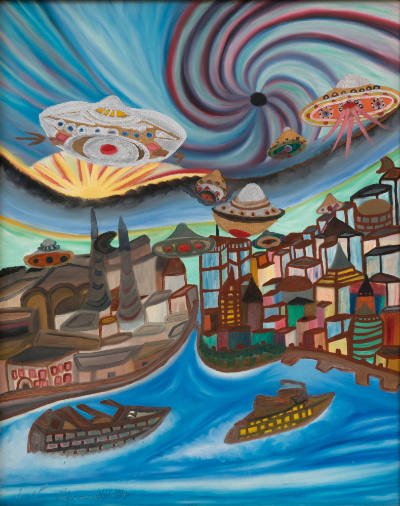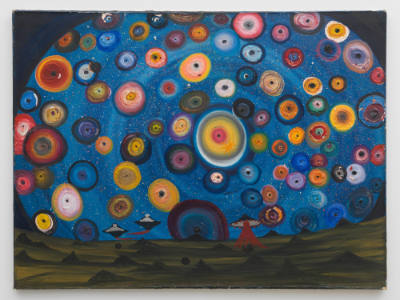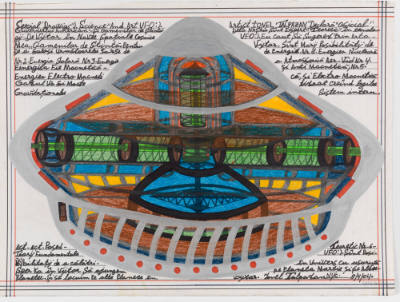
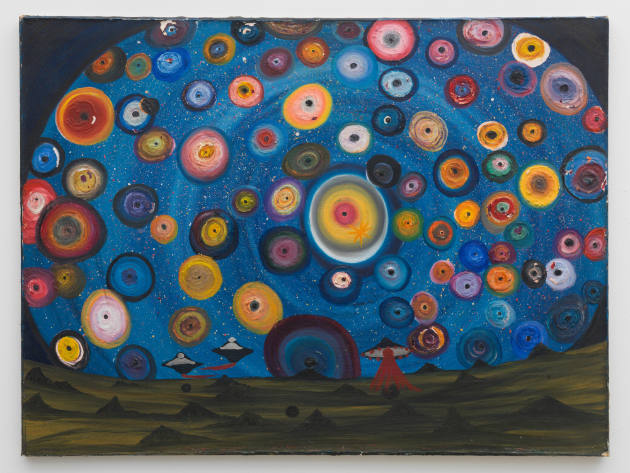
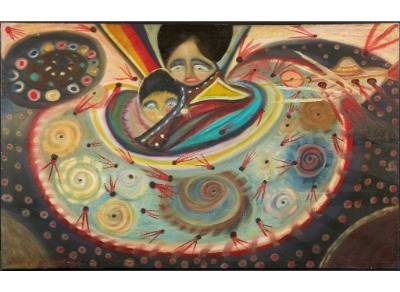
Ionel Talpazan created hundreds of paintings, drawings, and sculptures of UFOs as he considered how this otherworldly technology could hold utopian possibilities for Earth. Some of his first works were autobiographical, reflecting on his formative interest in the cosmos; Father and Son in Space (1992), for instance, features two figures in a swirl of galactic forms. Talpazan spent most of his life separated from his family and impoverished, his art acting as a place to find wonder in the universe. Few people appear in his later paintings, most of which are vivid depictions of spacecraft hovering over skylines or surrounded by circular patterns. Others reveal the interior workings of the UFOs through annotated diagrams that are reminiscent of mandalas in their detailed symmetry. He regularly used his fingers to paint, giving his art an expressionistic texture; on the reverse of pieces, he frequently added his handprints to his signature. He sold many of his paintings and drawings, made with marker and felt-tip pen, on the streets of New York City—where he also sometimes lived—alongside plaster sculptures of UFOs made from discarded materials.
Talpazan was born in the commune of Petrachioaia, Romania, in 1955; at first raised by his grandparents, he was later put into foster care. One night in the woods, having fled abuse from his foster family, he had a transformative experience. As he recalled, he was enveloped by a “blue energy that covered me,” which he interpreted as a UFO. In 1987, he escaped Romania’s oppressive communist regime by swimming across the Danube River to Yugoslavia. As a political refugee, he immigrated to the United States. In his adopted home of New York, art became an obsessive practice that gave him solace. “My art shows spiritual technology, something beautiful and beyond human imagination, that comes from another galaxy,” he said in a 2008 article in Western Folklore. “Something superior in intelligence and technology. So, in relative way, this is like the God, it is perfect.”
His early exhibitions included work in a 1997 show at American Primitive Gallery in New York and in the 1999 exhibition We Are Not Alone: Angels and Other Aliens at the American Visionary Art Museum in Baltimore. In 2014, the year before he died, he became an American citizen and changed his name to Adrian DaVinci.
Allison C. Meier, 2025
Text written as part of “Rethinking Biography,” an initiative supported by the Institute of Museum and Library Services (IMLS).
![Ionel Talpazan, “Mysterios Energie din Cosmos UFOs [Mysterious Energy from the Cosmos UFOs]”, N…](/internal/media/dispatcher/26283/thumbnail)